
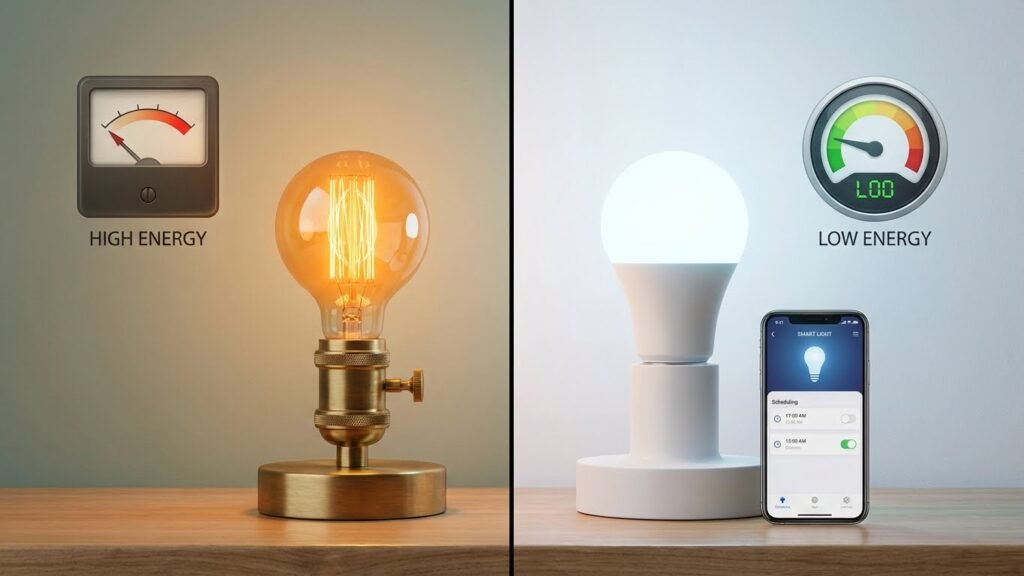
You can save energy by switching to smart LED bulbs, because they use the same efficient LED tech as regular LEDs and add features that cut wasted power. Smart bulbs often use little electricity when lit and can cut overall use further with scheduling, dimming, and automation.
You will want to weigh small extra standby use from some models against the savings from smarter control. Pick ENERGY STAR or low-standby models, dim when possible, and use timers or motion sensors to make the biggest impact.
Key Takeaways
- Smart LEDs use efficient LED technology and can reduce energy use.
- Features like dimming and scheduling boost real-world savings.
- Choose low-standby, certified models to maximize efficiency.
Understanding Smart Bulb Energy Efficiency
Smart bulbs save far more energy than old incandescent bulbs, but they can draw a small extra amount when idle. You will see how they use power, how they compare to traditional bulbs, and what ratings help you judge real efficiency.
How Smart Bulbs Use Electricity
Smart bulbs use LED light sources, which convert most electricity into light instead of heat. When the bulb is on, the LED driver and the smart features (Wi‑Fi, Zigbee, Bluetooth) all draw power. Typical LED light output for a 60‑watt equivalent is about 8–12 watts in operation.
When the bulb is turned “off” from an app or voice assistant, the radio and internal electronics often stay powered. That standby draw is usually under 1 watt for modern bulbs, but some models can use a few watts if they keep a strong network link. Dimming and color changes cut light output and lower running watts, so using lower brightness saves energy.
Comparing Power Consumption to Traditional Bulbs
Compare using simple numbers to see the difference. A common incandescent 60W bulb uses about 60 watts when on. A smart LED giving the same light uses about 8–12 watts. That means a smart LED uses roughly 80–87% less power while lit.
Include standby in calculations. If your smart bulb draws 0.5 W standby, that adds about 4.4 kWh per year running 24/7 in standby. Even with that, annual energy use stays far below an always‑on incandescent. You will save most when bulbs run many hours per day and when you use dimming, schedules, or motion sensors to cut run time.
Energy Efficiency Ratings for Smart Bulbs
Look for these labels and specs when you buy: luminous efficacy (lumens per watt), wattage, and standby power. Luminous efficacy tells you how much light you get per watt. Higher lumens per watt means better efficiency.
Also check ENERGY STAR or equivalent certifications for smart bulbs, which test both light output and standby draw. The product spec sheet should list lumens, input watts, and standby watts. Use that data to compare models side‑by‑side. A quick checklist:
- Lumens and input watts → compute lumens/watt.
- Standby watts → estimate yearly phantom load.
- Certifications → verify tested performance.
Technology Features That Improve Efficiency
Smart bulbs cut energy use by combining efficient light sources with controls that limit runtime, lower brightness, and react to presence and daylight. You get less wasted electricity, longer bulb life, and more control over when and how much light runs.
LED vs. Incandescent Technology
LED bulbs use semiconductor chips to produce light, so they convert most electrical energy into light instead of heat. A 9–12W LED gives the same brightness as a 60–75W incandescent, so you can expect roughly 75–85% lower wattage for the same lumen output.
LEDs last far longer than incandescents. Typical LEDs run 15,000–25,000 hours or more, while incandescents often last 1,000–2,000 hours. That reduces replacement frequency and lifecycle energy costs.
LEDs maintain efficiency across dimming and smart controls better than incandescents. They reach full brightness instantly, and their light quality (measured in lumens per watt and CRI) stays consistent. Choose ENERGY STAR-rated LEDs to ensure tested efficiency and lower standby power use.
Dimmability and Scheduling
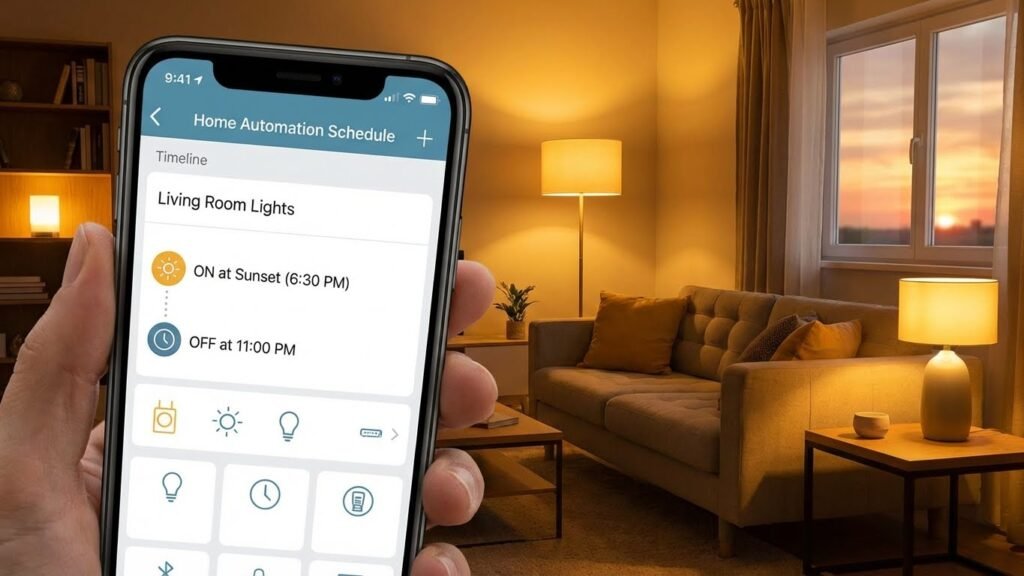
Dimming lowers bulb power draw directly. When you reduce brightness to 50%, an LED typically uses roughly half the power, though exact savings vary by driver design. Use dimming for areas where full brightness isn’t needed, like living rooms and bedrooms.
Scheduling cuts wasted on lights left on by accident. Set timers for routines: lights off during work hours, on for evening safety, and lower levels at night. You can program schedules by room or scene to match typical use patterns and reduce total on-time.
Combine dimming with schedules for best results. For example, set living room lights to 70% at 6–9 PM, then 30% overnight. That simple change reduces energy use and keeps the space comfortable.
Smart Sensors and Adaptive Lighting
Motion sensors stop lights from running in empty rooms. In hallways, bathrooms, and garages, occupancy sensors can drop runtime to seconds or minutes after no movement. That prevents long periods of unnecessary lighting.
Daylight sensors adjust brightness based on natural light. In rooms with large windows, sensors lower artificial light during daytime and raise it as daylight fades. This reduces electric lighting needs without sacrificing comfort.
Adaptive systems learn your habits. They can combine motion, daylight, and schedules to dim or shut off lights automatically. When you place sensors and tune sensitivity, you cut both on-time and peak usage while keeping the light where you need it.
Cost Savings and Environmental Impact
Smart bulbs cut energy use and lower bills compared with incandescent bulbs. They also reduce greenhouse gas emissions when you replace older, less efficient lamps and use automation to avoid wasted light.
Long-Term Electricity Savings
Smart LED bulbs use about 7–12 watts to match a 60-watt incandescent, so you save roughly 80% on lighting energy per bulb. If you run one replaced bulb 3 hours per day, you save about 54–66 kWh per year, which translates to tangible dollar savings depending on your local electricity rate.
You can boost savings with schedules, motion sensors, and dimming. Automations that switch lights off in empty rooms or dim them at night cut wasted hours. Over 5–10 years, reduced energy use plus the longer life of LEDs (often 15,000–25,000 hours) lowers total ownership cost despite higher upfront prices.
Consider standby draw and hub needs. Some smart bulbs or hubs use small amounts of power while idle, so factor that into annual totals. Still, the net electricity savings usually outweigh these small standby draws.
Impact on Carbon Footprint
Replacing incandescent bulbs with smart LEDs reduces carbon emissions because LEDs need less electricity to produce the same light. For example, saving 60 kWh per year avoids roughly 30–50 pounds (14–23 kg) of CO2 annually, depending on your grid’s emission factor.
Automation strengthens that reduction by cutting unnecessary on-time. Motion sensors and geo-fencing prevent lights from burning when no one’s home, shrinking your household’s indirect emissions from electricity.
Also consider manufacturing and disposal: LEDs use fewer materials and last longer, which lowers lifecycle emissions versus frequent replacement of incandescent bulbs. Recycle bulbs when possible to minimize environmental impact from waste.
Real-World Performance of Smart Bulbs
Smart bulbs cut wattage compared with incandescents and add small standby draw and smart features. You can expect large savings when bulbs replace old incandescent lamps, and small differences compared to regular LED bulbs.
Measured Energy Usage in Homes
When you swap a 60 W incandescent for a 9–10 W smart LED, you save about 50–55 W whenever the light is on. In real homes, this often translates to tens of dollars a year per frequently used fixture. For example, a living-room lamp used 4 hours per day at 10 W uses about 14.6 kWh per month; the same lamp as a 60 W incandescent would use about 87.6 kWh.
Bulbs that support dimming or color changes reduce use further when dimmed. Schedules and motion sensors cut run time, especially in hallways and bathrooms. If you replace all household incandescents with smart LEDs, expect a clear drop in annual consumption and utility cost.
Energy Loss in Standby Mode
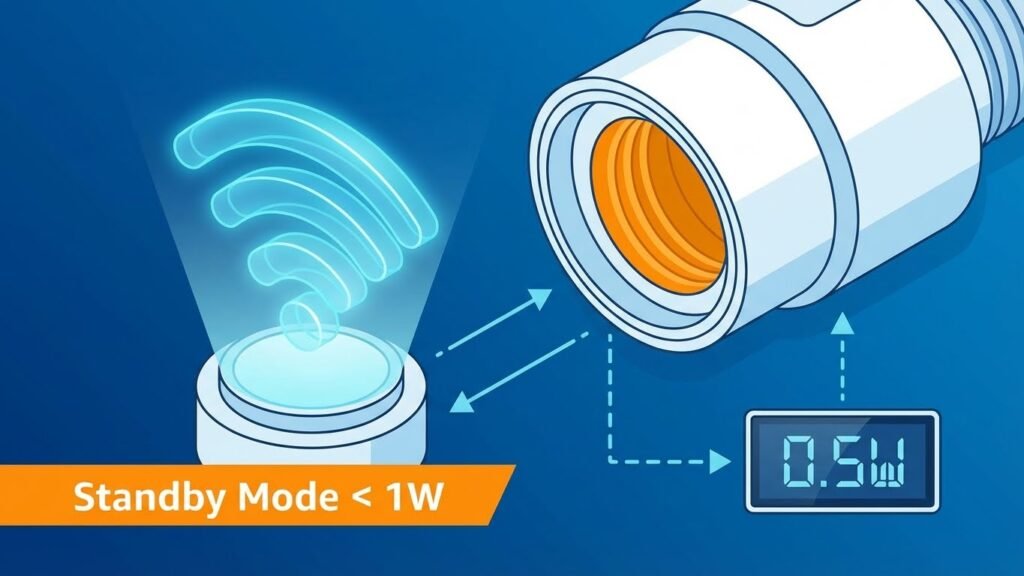
Most modern smart bulbs draw a small amount of power when “off” to maintain network connectivity. Typical standby draw sits under 1 watt for many models. That adds roughly 8–9 kWh per year per bulb at 1 W, which equals only a few dollars a year depending on your electricity rate.
If you have many bulbs, standby adds up: 10 bulbs at 1 W each use about 87.6 kWh per year. You can avoid standby draw by using a switched outlet, a smart switch that cuts power, or bulbs with truly zero-power “off” states. Check product specs for measured standby watts before you buy.
Factors That Influence Smart Bulb Energy Efficiency
Key drivers of smart bulb efficiency include how you use the lights and how the bulbs work with your other devices. Small choices—schedules, brightness, and hub use—can change your energy use noticeably.
User Habits and Automation
Your daily habits shape most of the energy savings. If you leave lights on for long periods, even efficient LEDs will raise your bill. Use timers and motion sensors to cut on-time; set schedules so lights turn off when rooms are empty.
Dimming saves energy when you don’t need full brightness. Program scenes for common tasks—reading, watching TV, or sleeping—so bulbs run at lower wattage automatically. Also check bulb color temperature: warmer settings sometimes use slightly less power than bright, cool white modes.
Standby features matter too. If you rely on voice assistants that keep bulbs always connected, expect a small continuous draw. You can limit that by disabling unnecessary cloud features or using local-only modes when available.
Compatibility With Other Smart Devices
Compatibility affects both convenience and energy use. If your bulbs work with a central hub or smart switch, you gain reliable automation that reduces wasted light. Confirm protocol support (Zigbee, Z-Wave, Bluetooth, or Wi‑Fi) so your devices talk directly without extra bridge power overhead.
Smart switches can cut standby draw by cutting power at the circuit level while preserving smart control via the hub. But some switches break smart functions; pick models designed to work with your bulb type.
Integrations with motion sensors, thermostats, and routines help coordinate lighting with occupancy and daylight. That coordination removes manual control and often yields the biggest energy savings over time.
Choosing the Most Energy Efficient Smart Bulbs
Pick bulbs with clear energy ratings and the right brightness and controls for each room to cut watts and runtime. Look for labels that show lumens per watt, lifetime hours, and smart features like scheduling or motion control that reduce on-time.
Understanding Efficiency Labels and Certifications
Check for ENERGY STAR and lumens per watt (lm/W) on the package. ENERGY STAR bulbs meet strict efficiency and light quality tests. Aim for at least 80–100 lm/W for general-purpose bulbs; higher is better.
Look for CRI (Color Rendering Index) of 80+ for accurate colors and rated lifetime (e.g., 15,000–25,000 hours). Also note wattage equivalence, so you compare lumen output to the old incandescent baseline (e.g., 800 lumens ≈ 60W incandescent).
If available, prefer bulbs with energy monitoring or standby power specs. Some smart bulbs use a small amount of power when idle; check manufacturer specs for standby watts to avoid surprises.
Selecting Based on Room and Usage
Match brightness, color, and control features to the room’s purpose. Use warm white (2700–3000K) and 600–800 lumens for living rooms and bedrooms. Choose cooler light (3000–4000K) and higher lumens for kitchens and work areas.
Use dimmable bulbs or bulbs with scheduling in rooms you often leave on. Install motion or ambient-light-triggered bulbs in hallways and closets to cut run time. For fixtures on long circuits, pick bulbs with lower standby draw or that can be switched fully off by your smart hub.
Buy multi-packs for consistent color and lower cost per bulb. Verify compatibility with your hub, voice assistant, or mesh system to avoid extra hardware that defeats efficiency gains.
Future Trends in Smart Bulb Efficiency
Smart bulbs will get more efficient through new hardware, smarter software, and stronger rules for how products are tested and labeled. Expect improvements that cut power use, boost useful light output, and make savings easier to measure and control.
Emerging Technologies
You will see microLEDs and improved phosphor LEDs in mainstream bulbs. These emit more lumens per watt and degrade slower than older LEDs, so they keep brightness while using less power. Manufacturers are also adding chip-level dimming and better thermal designs to prevent heat loss that wastes energy.
AI-driven control is becoming common. Bulbs will learn your habits and adjust brightness and color to save energy automatically. Mesh radio standards like Matter reduce the need for always-on hubs, lowering standby power. Some bulbs will include basic sensors (motion, ambient light) so lights switch off when not needed.
Evolving Industry Standards
Testing and labeling will move from lab estimates to real-world metrics you can trust. Expect new standards that rate bulbs on delivered lumens per watt at typical home settings, not just peak output. That helps you compare actual energy use across brands.
Policy and certification will emphasize standby power and network energy use. Look for labels that list: power in active use, standby draw, and recommended control settings. Smart-home certification programs will also require firmware update support to ensure efficiency gains from software continue over the bulb’s life.
FAQs
Do smart bulbs save energy compared to traditional bulbs?
Yes. Smart bulbs use LED technology, which uses far less power than incandescent bulbs for the same light output. You can also dim them or schedule times to cut use further.
Do smart bulbs use more energy than regular LED bulbs?
A little, sometimes. Smart bulbs draw a small amount of standby power for connectivity (often under 1 watt). That extra draw is usually minor compared to the energy you save from LED lighting and smart controls.
Will smart bulbs lower my electricity bill?
They can. Savings come from lower wattage, dimming, motion schedules, and avoiding lights left on by mistake. How much you save depends on your habits and how many bulbs you replace.
Are all smart bulbs equally efficient?
No. Look at lumen output (brightness) and wattage to compare efficiency. Choose ENERGY STAR models when possible and pick bulbs with dimming and good scheduling features.
Can smart bulbs last as long as regular LEDs?
Yes. Lifespan depends on build quality and usage patterns. Smart bulbs often last as long as regular LEDs, but heavy network use or heat can reduce life.
Are there any privacy or network concerns?
Some smart bulbs connect to a hub or Wi‑Fi and can be updated over the internet. Keep firmware updated and use strong Wi‑Fi passwords to reduce risks.
How do I maximize efficiency with smart bulbs?
Use schedules, dimmers, motion sensors, and group controls. Turn off or set lower brightness for rooms you use rarely.
Conclusion
Smart bulbs use LED technology and usually draw far less power than old incandescent bulbs. You will save energy when you replace traditional bulbs with quality smart LEDs, especially if you use dimming, schedules, or motion sensors.
Your actual savings depend on how you use the lights. If you keep smart bulbs on all day, savings shrink. If you automate off times, dim when possible, and pick efficient models, you get the most benefit.
Smart features add a small extra standby draw and sometimes a higher upfront cost. Factor those into your buying choice. For product specs and measured power use, check manufacturer datasheets or testing by organizations like ENERGY STAR.
If you want simple steps, start by swapping high-use fixtures to smart LEDs, enable schedules, and use scenes to lower brightness. Over time, the lower energy use and longer bulb life usually offset the cost difference.
For reliable guidance on energy savings and labeling, consult the U.S. Department of Energy or the ENERGY STAR program for details on LED efficiency and testing.