
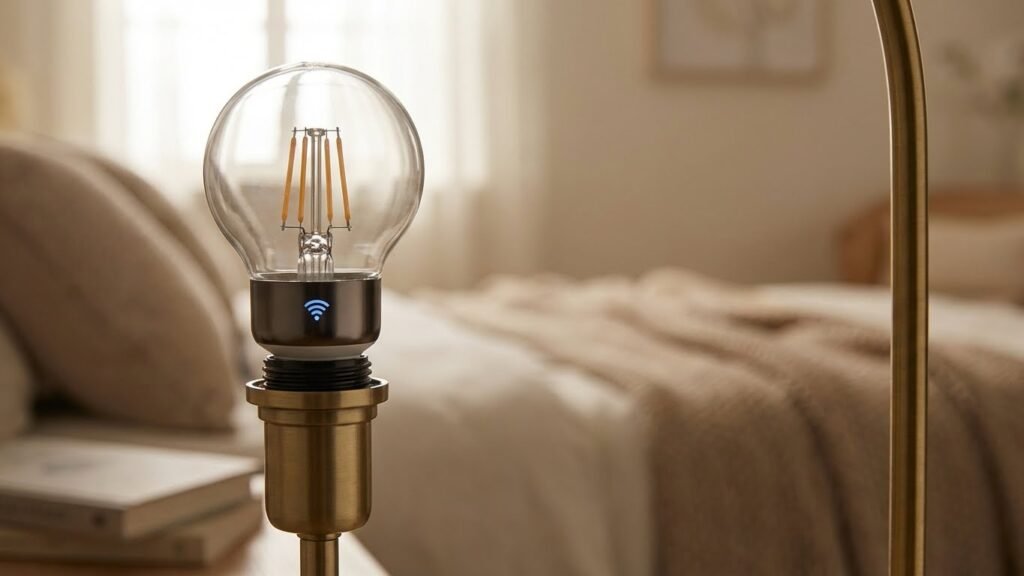
Smart bulbs often draw a small amount of power even when they look off, because their wireless radios and control electronics stay ready to respond. Most modern smart bulbs use roughly 0.2–2 watts in standby, so they do consume a bit of electricity while off.
If you care about bills or standby waste, this tiny draw can add up over months, but it usually costs only a few dollars per year per bulb. You can cut that further by using smart switches, turning off hubs, or choosing bulbs with lower standby ratings.
Key Takeaways
- Smart bulbs commonly use small standby power when switched off.
- Standby draw rarely raises bills much, but it is measurable.
- You can reduce standby use with switches or low-standby models.
Understanding Smart Bulb Power Consumption
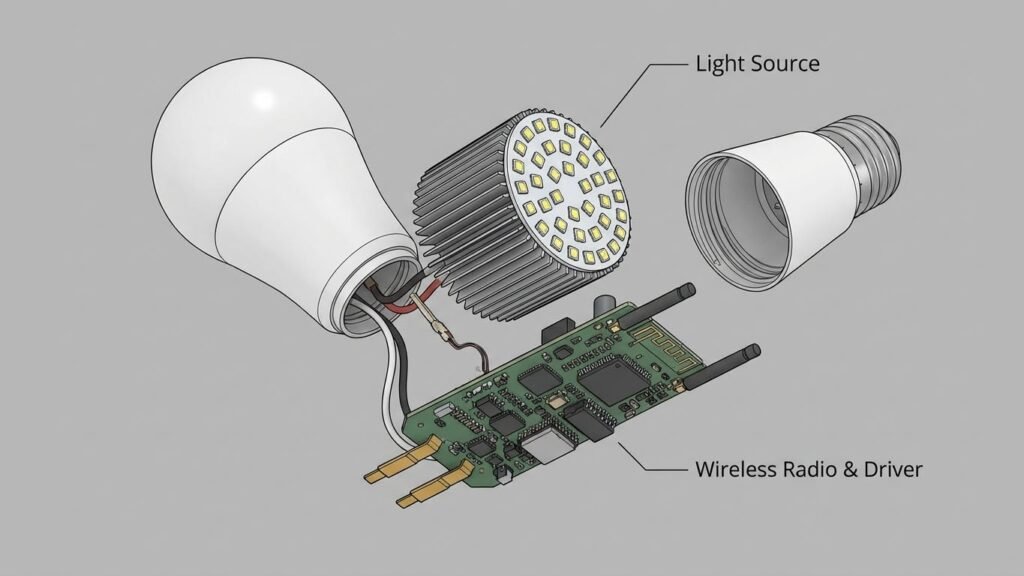
Smart bulbs draw a small amount of power even when the light is off. You’ll see how the bulb’s electronics, standby modes, and communication features determine that draw.
How Smart Bulbs Work
A smart bulb contains an LED light source and small electronics that let it connect to apps, hubs, or voice assistants. When you turn the light “off” with an app or voice command, the bulb often keeps its wireless radio and microcontroller powered so it can receive the next command.
Most smart bulbs use Wi‑Fi, Zigbee, or Bluetooth. Wi‑Fi bulbs tend to use more standby power than Zigbee or Bluetooth because Wi‑Fi radios stay active to maintain a network connection. The bulb still switches the LEDs off, but the control circuitry remains partially powered.
You control most settings through the cloud or a local hub. That control convenience causes the tiny, continuous energy use that shows up on your bill only after long use or many bulbs.
Standby Power Explained
Standby power means electricity used while the bulb appears off. It typically ranges from less than 0.5 watts to a few watts per bulb, depending on design. At 0.5 W, one bulb uses about 4.4 kWh per year; at 2 W, it uses about 17.5 kWh per year.
The actual cost depends on your electricity price and how many bulbs you have. If your utility charges $0.15 per kWh, a 0.5 W bulb costs about $0.66 per year, while a 2 W bulb costs about $2.63 per year. Standby power adds up in homes with many smart bulbs or other always‑on devices.
Smart Bulb Components Influencing Energy Use
Key parts that affect standby draw include the wireless radio, microcontroller, power supply, and sensors. Radios (Wi‑Fi > Zigbee/Bluetooth in power use) are often the largest standby consumers. Microcontrollers need a small constant current to keep the device responsive.
Power supplies (drivers) convert AC to low‑voltage DC and add loss. Cheaper drivers can waste more energy. Some bulbs include motion or ambient light sensors that require extra standby power. Energy‑saving choices include bulbs labeled for low standby or using a hub that lets the bulb’s radio sleep more.
Electricity Usage When Smart Bulbs Are Off
Smart bulbs usually draw a small amount of power when switched off so they can listen for wireless signals and keep internal electronics ready. That standby draw is typically under 1 watt per bulb, but it adds up if you have many bulbs on the same circuit.
Reasons for Standby Electricity Use
Smart bulbs contain a tiny computer, a wireless radio, and control circuitry. These parts need power to stay connected to your network and to respond quickly to app commands or voice control.
You may also see power used for periodic checks, firmware updates, or maintaining memory settings like color and brightness. The electronics draw far less power than when the bulb is lit, but they never fully power down while the bulb is in “off” mode.
If you unplug or cut power at the switch, the bulb uses zero standby power. Using a smart plug or a physical switch that removes power stops the draw but also disables remote control until power resumes.
Energy Draw and Wireless Connectivity
Most smart bulbs use Wi‑Fi or Zigbee and consume around 0.2–1.0 watts while idle. Wi‑Fi bulbs often sit toward the higher end of that range because the Wi‑Fi radio uses more energy than low‑power mesh radios like Zigbee.
That standby consumption equals roughly 1–8 kWh per bulb per year depending on the wattage and local electricity rates. For one bulb this cost is small; for dozens of bulbs it can be noticeable on your bill.
You can cut standby use by choosing Zigbee or Bluetooth models, using room-level smart switches, or scheduling bulbs to fully lose power when you don’t need remote control.
Comparison With Traditional Bulbs
Traditional incandescent or non‑smart LED bulbs draw effectively zero power when switched off because they lack electronics that stay powered. A physical wall switch that removes line power makes smart bulbs behave the same way.
Smart LED bulbs are more efficient when lit than incandescents, often using 7–10 watts to produce the same light that a 60W incandescent would. So even with small standby draw, smart bulbs usually save energy overall if you use their dimming and scheduling features.
If you want no standby use at all, use smart bulbs with master switches that cut power, or place them on smart outlets that fully disconnect power on schedule.
Measuring Standby Power of Smart Bulbs
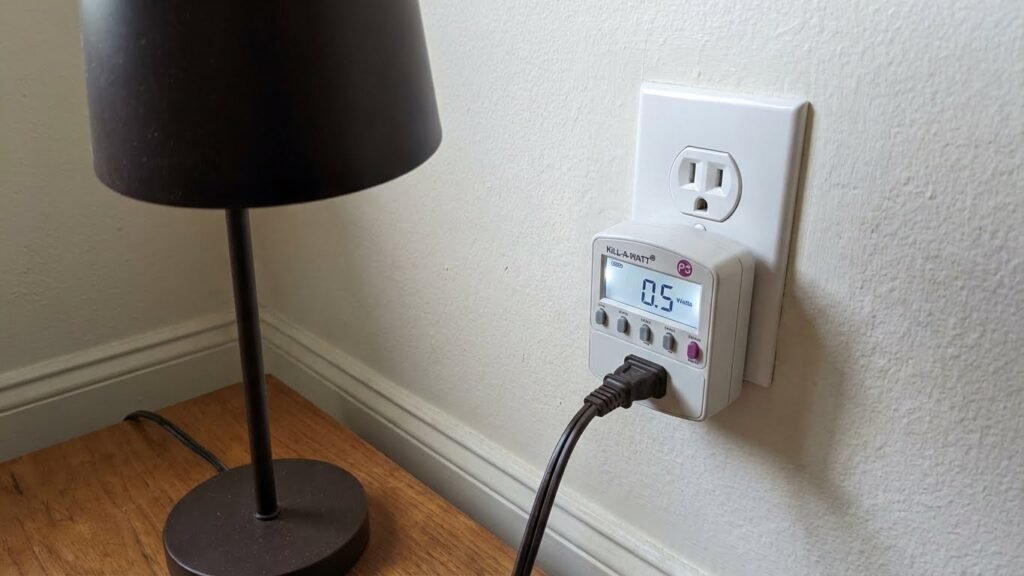
You can check a smart bulb’s idle draw with simple tools or by reading specs. Typical standby draws are small, but measuring confirms the exact number for your model.
Methods to Measure Power Consumption
Use a plug-in power meter (kill‑a‑watt style) for the easiest test. Screw the bulb into a lamp, plug the lamp into the meter, set the bulb to “off” via its app or switch, and read watts. Take readings after the bulb has been off for several minutes to avoid transient activity from network traffic or updates.
If you want more precise data, use a true RMS meter or a bench power analyzer that logs watts over time. Record average power for at least 30 minutes to capture brief spikes from wireless activity. For Wi‑Fi bulbs, test with the network connected and then with the bulb disconnected to see the difference.
Always note conditions: bulb model, firmware version, network type (Wi‑Fi, Zigbee, Bluetooth), and whether any automation is active. These details explain why readings differ between tests.
Typical Standby Wattage Range
Most modern smart LED bulbs draw between about 0.2 W and 0.5 W when “off.” Some models, especially older or Wi‑Fi‑heavy bulbs, can reach 0.5–1 W in standby. These numbers come from measurements across many consumer models.
To put that in context, 0.5 W running 24/7 uses about 4.38 kWh per year. At typical electricity rates, that equals only a few cents annually per bulb. Still, if you have many smart bulbs, the totals add up; measuring your own bulbs tells you whether they sit near the low end or the higher end of this range.
Impact on Electricity Bills
Smart bulbs use a small amount of power when “off,” but that amount and your number of bulbs determine the real cost. You can compare standby watts, bulb count, and local electricity rates to see the likely yearly impact.
Calculating Annual Cost
To estimate cost, multiply standby watts by hours per year (8,760), then convert to kilowatt-hours (kWh).
Example: a bulb using 0.5 W standby → 0.0005 kW × 8,760 hr = 4.38 kWh per year.
Use this quick table to compare:
| Standby power (W) | kWh/year (per bulb) | Cost/year at $0.15/kWh |
|---|---|---|
| 0.2 | 1.75 | $0.26 |
| 0.5 | 4.38 | $0.66 |
| 1.0 | 8.76 | $1.31 |
Multiply by the number of bulbs you own. If you have 10 bulbs at 0.5 W, expect ~43.8 kWh or ~$6.57 per year at $0.15/kWh. Small differences in standby power rarely raise bills significantly.
Long-Term Financial Impact
Standby consumption adds up slowly but stays constant year to year. Over 5–10 years, each bulb at 0.5 W costs about 22–44 kWh, or roughly $3–6 at $0.15/kWh.
Factor in replacement and features. Smart bulbs cost more upfront than regular LEDs. But they can lower overall energy use through dimming, scheduling, and automation, which may offset standby costs if you use those features to reduce “on” hours.
If you want to eliminate standby draw entirely, you can use smart plugs, switch to non-smart LEDs on circuits where automation isn’t needed, or choose bulbs with lower standby ratings. Make decisions based on how many bulbs you have and how often you rely on smart features.
Ways to Minimize Standby Consumption
You can cut standby draw by removing power when the bulb doesn’t need smart features and by picking bulbs that use very low standby watts. Small changes add up across many bulbs.
Unplugging or Power Cutting Solutions
Cutting power at the fixture or switch removes standby draw completely. Use wall switches, inline smart plugs with a physical switch, or a switched circuit to kill power when you don’t need remote control or automation. Mechanical toggle switches are the simplest option.
If you use smart plugs, choose ones with a true power switch rather than only an app control. That way you can turn the outlet off and the bulb draws zero watts. For ceiling fixtures where you cannot easily reach the switch, install a local switch or a labeled breaker tied to the circuit.
Be aware that cutting power disables remote control, schedules, and voice commands until you restore power. If you rely on motion triggers or safety lighting, keep those bulbs powered or use a hybrid approach: leave a few essential fixtures live and switch off the rest.
Choosing Energy-Efficient Models
Look for smart bulbs that list standby power in their specs. Aim for bulbs that show 0.2–0.5 W standby or lower. Manufacturers sometimes publish “standby” or “inactive” wattage on the product page or datasheet.
Prefer bulbs with Zigbee or Thread protocols if you use a hub. These often use less standby power than Wi‑Fi bulbs because they rely on a low-power mesh network. Also check for firmware updates; some vendors release updates that reduce standby draw.
Compare lumen output to on-state watts to judge efficiency. A bulb that gives 800 lumens at 7 W and 0.2 W standby is better than one that uses 10 W and 1 W standby. Buy from brands that publish real-world test results or independent lab measurements.
Smart Bulbs and Environmental Considerations
Smart bulbs use LED technology and a small amount of standby power for connectivity. They cut running energy compared with incandescent bulbs but draw a fraction of a watt when “off,” which can affect very large installations.
Energy Efficiency Versus Traditional Lighting
You get far lower runtime energy with smart LEDs than with incandescent bulbs. A typical smart LED uses about 7–10 watts to match a 60-watt incandescent when on, which cuts energy use by roughly 80–90% for the same light output.
When “off” but connected, many smart bulbs draw less than 1 watt for Wi‑Fi, Bluetooth, or Zigbee radios and internal electronics. That standby draw adds a small amount to your bill: for a single bulb it’s cents per year, but for hundreds of bulbs it becomes noticeable.
If you compare smart LEDs to regular (non‑smart) LEDs, the on-state energy is similar. The trade-off is the extra standby power for connectivity versus the savings from better control, scheduling, and automation that reduce overall on-time.
Environmental Advantages of Smart Lighting
You reduce greenhouse gas emissions by using less electricity when bulbs are on. Because LEDs last longer—often 15,000–25,000 hours—you also cut waste and the frequency of replacements. That lowers material use and landfill impact over time.
Smart controls help you avoid wasted light. Features like motion sensors, schedules, and remote shutoff mean lights operate only when you need them. That can multiply savings across homes, offices, and buildings.
Consider lifecycle impacts too: smart bulbs include extra electronics and networking components, which complicate recycling. If you plan to scale smart lighting, factor in proper recycling and choose bulbs from manufacturers with take‑back or recycling programs.
Common Misconceptions About Smart Bulb Power Use
Smart bulbs usually draw a tiny amount of power when “off,” and their total energy impact depends on how you use them and which model you buy. Expect small standby use, big savings compared with incandescents when lights are on, and variation by brand and features.
Myths Versus Facts
Myth: a smart bulb uses the same power when off as when on.
Fact: most smart LEDs draw under 1 watt in standby, often around 0.1–0.5 W. That is a small, continuous drain compared with 7–10 W when the bulb is lit.
Myth: the standby power will noticeably raise your electric bill.
Fact: at 0.5 W constant use, a bulb consumes about 4.38 kWh per year, roughly a few cents of cost depending on your rate. Multiple bulbs add up, but the summed standby cost is still far less than leaving old incandescent bulbs on.
Myth: turning the physical wall switch off saves the same as using the app.
Fact: a physical switch cuts power completely, so the bulb uses zero standby. Using the app or voice keeps the bulb ready and draws standby power, but gives remote control and automation.
Influence of Brand and Technology
Different brands and chipsets change standby draw and features. High-end bulbs often use better radios (Zigbee, Z-Wave, Wi‑Fi) and more efficient standby circuits. That can lower idle power to near 0.1 W. Cheaper bulbs may use older Wi‑Fi chips that draw closer to 1 W when idle.
Features matter too. Bulbs with color, built-in hubs, or sensors usually use more standby power than simple white dimmable bulbs. Firmware and encryption can also affect power use during sleep and wake cycles.
If you want the lowest idle use, look for verified standby specs on the product page or energy-label tests. You can also reduce wasted power by using smart switches, motion sensors, or cutting power at the wall when remote control isn’t needed.
Conclusion
You can expect a smart bulb to use a small amount of electricity when it’s turned off. Most modern models draw between about 0.2 and 2 watts in standby while they stay connected to your network and await commands.
That tiny draw adds up slowly. If you have many bulbs, or run them 24/7 in standby, the annual cost can reach several dollars per bulb, depending on your local electricity rate.
Choose bulbs that list low standby power or look for ENERGY STAR certified models to cut that waste. You can also limit standby use by powering bulbs with a switched circuit, using smart plugs that cut power, or grouping fewer always-connected devices.
If your main goal is energy savings, smart LEDs still beat old incandescent bulbs when lit. Balance the small standby use against features you want—automation, scheduling, and remote control—so your lighting fits your needs without unnecessary cost.
FAQs
Do smart bulbs use power when they are off?
Yes. Smart bulbs usually draw a small amount of standby power so they can listen for commands. Most modern bulbs use under 1 watt when “off,” though some older models may use more.
How much will that standby power cost me?
Standby draw is very low. At typical rates, less than 1 watt of continuous use adds only a few dollars per year per bulb. The exact cost depends on your local electricity price and how many bulbs you have.
Can I stop the standby power draw?
You can. Use a physical switch, smart plug that cuts power, or an in-line relay to remove power completely. Be aware that cutting power may remove remote control and scheduled features.
Are smart bulbs still energy-efficient overall?
Yes. Smart LED bulbs save far more energy when on compared to incandescent bulbs. The small standby draw usually does not outweigh those savings.
Which bulbs draw the least standby power?
Newer and higher-quality smart bulbs tend to have lower standby use. Look for product specs that list “standby” or “idle” watts, or check independent tests before buying.
Conclusion
Smart bulbs do draw a small amount of power when they are turned off because they stay connected to your network and wait for commands. That standby draw is usually tiny — often well under 2 watts — but it can add up if you have many bulbs.
You can lower that standby use by picking energy-efficient models and turning off the hub or Wi‑Fi to the bulb when not needed. Using schedules, motion sensors, or smart plugs can cut the constant connection without losing control when you want it.
If you track costs, you’ll find the yearly expense per bulb is small. Still, saving a few watts across many bulbs can make a visible difference on your bill and reduce overall energy use. For more on measuring standby power, see guides from the U.S. Department of Energy and testing resources like Energy Star.