
Specs are compiled from manufacturer listings and verified buyer reviews and can change over time — please confirm the key details on the product page before buying.
Standing on a wobbly plank sounds like a neat extra, not a workout. Yet a yoga balance board quietly works your deep core muscles, ankles, and posture in ways a mat alone never will — the trick is picking the right one for your skill level, your floor, and your bare feet.
I’m Maruf — the founder and writer behind HomeYarr. This guide is built by comparing the manufacturers’ published specifications and the patterns across verified customer reviews, so you get each pick’s real strengths and trade-offs instead of marketing spin.
Your goals decide the board: surf training, ankle rehab, or a standing-desk fidget that pays off. Here is how the top contenders really compare, so you can match one to your routine.
Our Picks at a Glance

How To Choose The Best Yoga Balance Board
Before you buy, match the board type to your goal. A rocker board tips only side-to-side, making it the gentlest place to start. A wobble board tilts in every direction for a bigger challenge. A roller board — a deck on a cylinder — comes closest to the feel of a surfboard or skateboard and is the hardest to master.
Match the Board to Your Skill and Floor
The best pick for you depends on your starting point. Beginners do well with a wide board that has a larger, steadier base, while athletes who want sport-specific training usually prefer a roller deck. Whatever you choose, check the deck surface — some boards feel great on bare feet, while others are better with socks or shoes. Pay attention to your floor too: heavier wooden boards glide smoothly on carpet, while a lightweight plastic wobble board may slide on hardwood.
Quick Comparison
| Model | Best For | Board Type | Weight Capacity | Deck Dimensions | Amazon |
|---|---|---|---|---|---|
| Indo Board Original★ Best Overall | Surfers & athletes | Roller Board | 350 lbs | 30″L x 18″W | Amazon |
| CanDo Economy BoardBudget Champion | Physical therapy on a budget | Wobble Board | — | 14″L x 14″W | Amazon |
| StrongTek Wooden BoardDesk Companion | Standing desks | 360° Wobble | 350 lbs | 17.5″L x 13.5″W | Amazon |
| WOOD CITY Wobble Board | Toddler play & yoga | Rocker Board | 480 lbs | 35″L x 11.8″W | Amazon |
| BECAPRO Balance Board | Family & adjustable difficulty | Roller Board | 300 lbs | 29.1″L x 11.4″W | Amazon |
| Sportneer Balance Trainer | Versatile 7-mode workouts | Roller & Ball | 450 lbs | 30.09″L x 11.8″W | Amazon |
| XCMAN Surf Balance Board | Compact surf & skate training | Roller Board | 264 lbs | 29.53″L x 11.81″W | Amazon |
| Fitterfirst Professional Board | Ankle rehab & adjustable tilt | Wobble Board | 300 lbs | 16″L x 16″W | Amazon |
| Whirly Board Spinner | 360° spin & hockey agility | Spinning Board | 400 lbs | 32″L x 8.25″W | Amazon |
In‑Depth Reviews
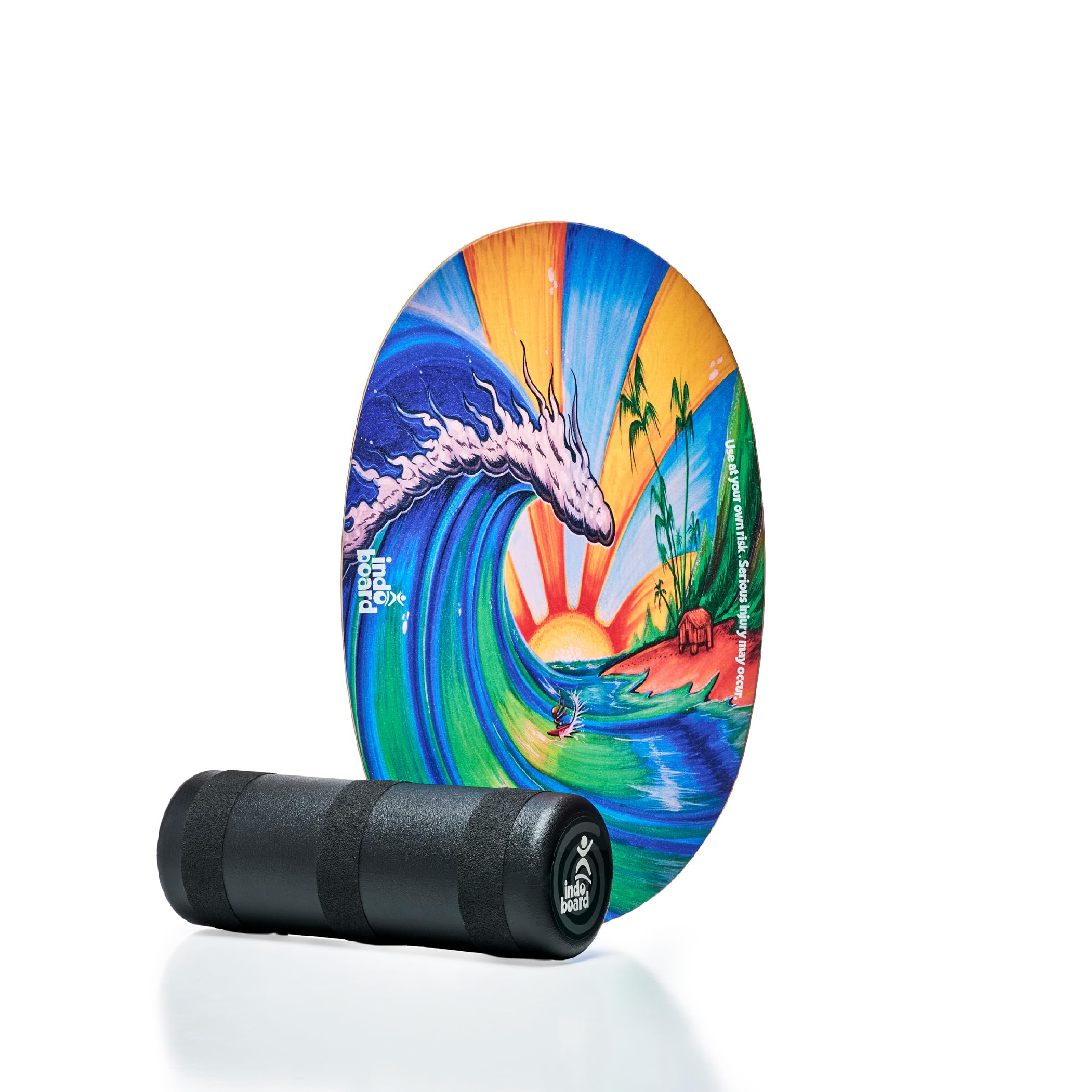
1. The Original Indo Board – Balance Board Trainer
Our pick — over 4.5★ from 900+ verified ratings; the strongest balance of quality and price.
The gold standard that turns your living room into surf training
If you want one board that does everything — surf prep, core work, kids’ snowboard practice — this is the one. The Indo Board pairs a 30″L x 18″W maple deck with a trackless roller that lets you move in any direction, not just front to back. At 13.8 pounds, it’s the heaviest board here, and that weight is exactly why it stays put on carpet and feels planted under you.
The wide tube demands real core and reflex work, making it a true advanced-level trainer. Owners describe it as an advanced board that tests your core, stability, and reflexes, with the wide tube demanding more than ball-style trainers. Beginners can still use it, but the smart move is grabbing the flo-cushion package for a stable yet challenging middle step. The deck’s gritty finish means you can ride barefoot comfortably, and the grippers and stoppers keep the roller from shooting out from under you.
What wins people over is the build. Buyers report: “Thick an heavy duty! Functions well, has really good grip on the board and balances well.” Nearly 30 years of design tweaks make it both beautiful and brutal, trusted by serious athletes.
What makes it the top pick
- Wide 18″ maple deck gives you room to find your footing
- Trackless roller moves in every direction for 360° training
- Gritty surface works great barefoot
- Supports up to 350 pounds
Who should think twice
- 13.8-pound weight is a lot to cart around — this stays home
- Steep learning curve; beginners will want the flo-cushion too
Reach for it if: you’re an athlete, a surfer, or someone who wants the definitive balance trainer that the whole family can grow into.
Look elsewhere if: you want something portable to slide in a gym bag — this one lives where you train.
2. CanDo 10-1745 Economy Balance Board
A featherweight wobble disc that costs less than a yoga class
This is the entry point that makes balance training cost-effective and fun. At just 1.25 pounds, it’s a tiny fraction of the Indo Board’s weight — you can toss it in a backpack and take it anywhere. The 14-inch plastic disc sits low to the ground, so even the nervous first-timer won’t have far to fall.
The textured surface with raised circles keeps your feet from sliding, and it’s a proven rehab tool. Owners praise its effectiveness for physical therapy, classroom seating, and water-based drills. It quietly builds ankle strength and calf tone during TV time.
There’s a catch, and it’s a real one: this is hard plastic, and it’s not comfortable on bare feet. Owners mention: “Very uncomfortable bare foot, makes it inconvenient at the house.” Wear socks or shoes, and it’s a non-issue. It also comes as a mid-difficulty wobble among three types, making it a sensible middle ground for most people.
Perfect for rehab: Owners consistently rely on this for physical therapy work, and the one-foot balance flow some people build around it is genuinely impressive — 10 poses per foot, no extra gear needed.
The honest trade-off: hard plastic means barefoot comfort is off the table, so pair it with grippy socks or shoes.
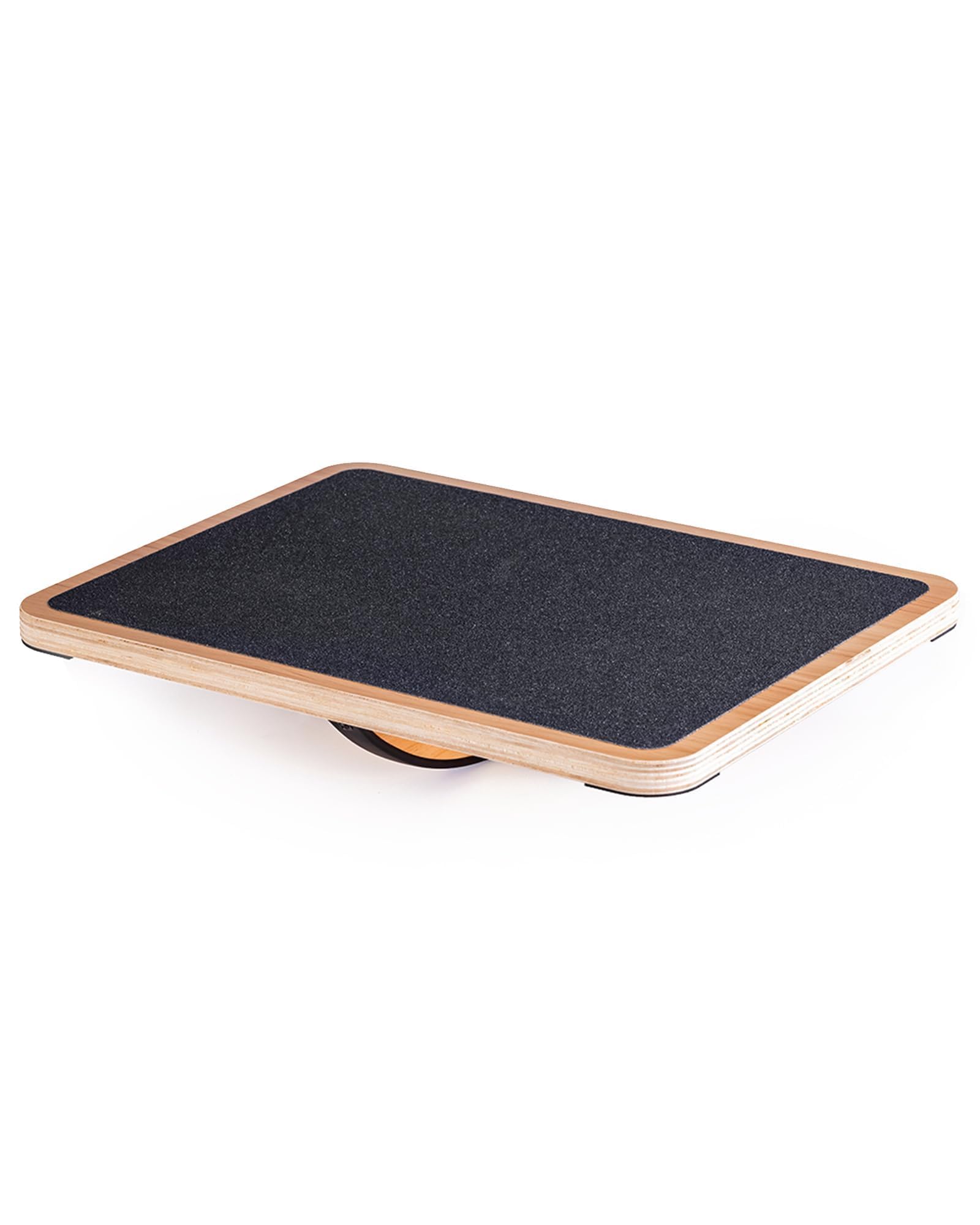
3. StrongTek Wooden Balance Board
The compact wobble board that makes standing desks bearable
This is the one for anyone who stands at a desk all day and wants their legs to stop feeling like lead. The StrongTek measures a compact 17.5″L x 13.5″W x 3″H, so it slides under a standing desk without turning your workspace into an obstacle course. Owners say it’s “very sturdy and compact. Perfect height for standing desk use.”
It’s designed as a middle step before full round-base boards. The cross-style base creates a larger floor contact area, which makes it more controlled and approachable than a traditional round ball board, while still giving you 360° directional wobble — not just the side-to-side rock of a basic rocker. That’s ideal for building the ankle and core control you need before graduating to harder gear.
Build quality is the headline here. Owners praise the solid wooden platform and the non-skid surface that keeps your feet planted as you shift weight. Like the Indo Board, it supports up to 350 pounds. The one recurring gripe? The corner pad adhesive isn’t sticky enough, and those edge protectors can fall off — a minor annoyance on an otherwise excellent board.
Built for daily micro-movement: At just 2.23 kg, it’s light enough to flip on its side and store against the wall when you’re done, yet sturdy enough for post-surgery therapy and calf stretches.
Minor friction point: expect the corner pads to need re-sticking — treat them gently and it’s a five-star experience.
4. WOOD CITY Wobble Board

A 35-inch curved plank that is toy, yoga prop, and furniture in one
This is the board that keeps the whole family busy. The WOOD CITY is a 35-inch-long curved rocker that does double duty as an open-ended toy for kids — a bridge, a shop, a slide, a tunnel — and a legitimate balance trainer for adults. Owners praise its dual role as a toddler toy and adult yoga prop.
It’s built to handle real weight too. The solid natural wood holds up to 480 pounds, so two kids or an adult can be on it at once. That’s the highest capacity in this lineup, and owners have tested it well past 220 pounds without a worry. The height tops out at 6 inches, which gives kids a safe rocking arc while still giving adults a genuine core challenge when they stand on the high center.
For parents, this is a no-brainer gift. Owners note it’s a hit with toddlers, siblings, and grandparents alike, and it shows no signs of wear with daily use. The one caution is the classic curved-board pinch hazard for little toes and fingers — it’s a design reality, not a flaw. It also doubles as a seat aid for stretching your back during yoga, making it one of the more flexible picks here.
One board, infinite uses: Because it’s a simple curved plank, there’s no roller or ball to lose — it’s a Montessori-style heirloom that grows with your child from 18 months up.
Watch little fingers: the rocker motion can pinch toes caught underneath, so keep a close eye on toddlers during play.
5. BECAPRO Balance Board Trainer

A roller board with three difficulty settings so the whole family can ride along
Here’s a board that actually grows with you. The BECAPRO uses four rubber stoppers and screw nuts to change how far the roller can travel, giving you three basic distances — 9.7, 15.2, and 23.5 inches. Set it short for the kids and beginners, then open it up as you improve. That adjustability makes it a true family board, and owners confirm everyone from a 5-year-old to a 235-pound adult can use it.
The construction is serious. It’s built from 11-ply, 18mm cold-pressed hardwood that supports up to 300 pounds on the deck, while the roller is 15mm of compacted industrial-use kraft paper that handles up to 500 pounds. The deck sports high-quality emery polishing paper to prevent slips, and dual nonslip strips on the back keep the whole thing from sliding on the floor. Owners describe it as rock solid — a 6’1″, 235-pound rider reports the board doesn’t flinch when he steps on.
What makes it stand out from the Indo Board is the progression. The Indo Board is a fixed challenge; the BECAPRO lets you dial the difficulty up and down on the fly. It’s the best choice if you’re buying for a household with mixed skill levels.
The adjustable advantage
- Three roller distances from 9.7 to 23.5 inches for easy-to-hard progression
- Supports 300 lbs on deck, 500 lbs on roller
- Emery surface keeps feet planted and safe
The trade-off
- At 29.1 inches long, it needs more floor space than compact wobble boards
- Roller is heavy-duty but not trackless — it moves in a straight line
Pick this if: you want one board that a kid can learn on and an athlete can still get a workout from, all by moving two stoppers.
skip it if: you want 360° movement — this is a front-to-back roller board, not a wobble.
6. Sportneer Balance Board

Seven challenge modes in one box, from beginner roller to expert ball
This is the Swiss Army knife of balance boards. The Sportneer ships with a roller, a 2.8-inch solid rubber ball, and rail pieces that combine into seven distinct challenge modes. Four magnetic stoppers snap in and out without tools, so switching from a gentle roller session to a wobbly ball balance takes seconds. It’s the kind of versatility that keeps a home gym interesting for months.
The deck is high-quality birch wood with a textured non-slip EVA top — a cushy, paddle-board-like surface that owners say feels great in socks, shoes, or barefoot. The whole thing supports up to 450 pounds, which is plenty for two people to share. The ball and roller are solid rubber, so they won’t damage floors or collect hair like foam alternatives.
Owners consistently praise its balance and build quality. It doubles as a surf trainer, snowboard trainer, or a pre-lift warm-up tool. Owners note the half-circle rails are a bit hard to remove without indentions — a minor ergonomic flaw — but they also call it great value and a family hit. It’s a wider deck than the XCMAN below, giving you more room to find your stance.
Buy it for progression: the 7 modes genuinely span beginner to expert, so you won’t outgrow it the way you might outgrow a single-mode board.
The minor gripe: the half-circle rails lack a finger hold, so swapping them takes a little effort — a small price for the variety.
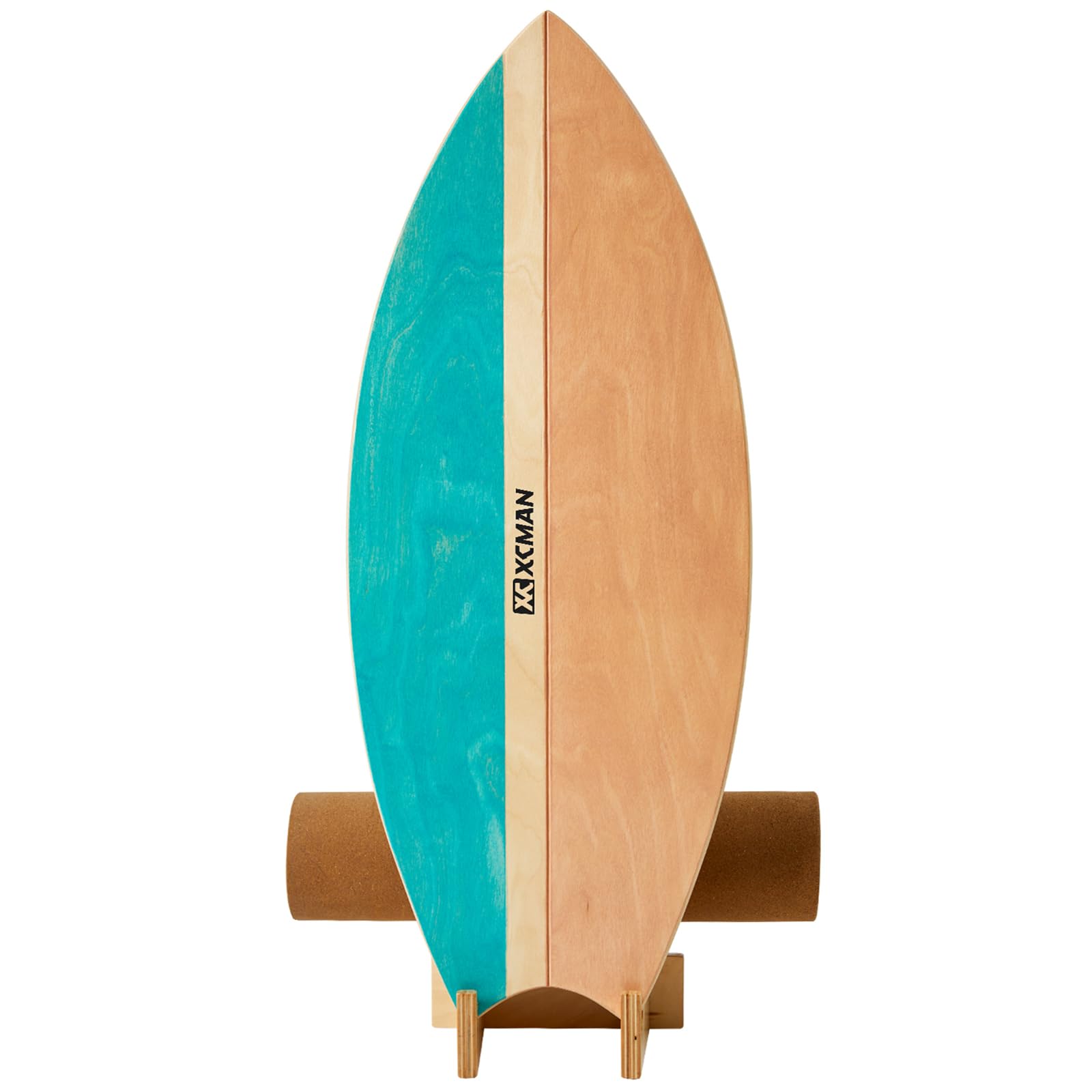
7. XCMAN Surf Balance Board Trainer
A featherlight 6.6-pound deck that slips into a corner when you’re done
If portability matters more than floor presence, this XCMAN is the one. At just 6.6 pounds, it’s roughly half the weight of the Indo Board, yet it still holds up to 350 pounds (listed as 120 kg). The 29.53-inch deck works on wood, carpet, cork, and concrete without scratching floors, so you can move it from the living room to the office without a second thought.
It’s built for surf and skate training. The matte surface provides non-skid grip, and the solid rubber roller glides smoothly. Owners — including a 17-year-old surfer — say it’s well-made, stable, and ideal for home surf practice. One rider notes it took about a month to hop on confidently, and that his balance improved significantly in that time. The deck is on the compact side, so it’s a touch small for very large feet, but for most people it’s just right.
Compared to the Sportneer above, the XCMAN is simpler and lighter. It skips the multi-mode gimmicks for a focused roller experience at a lower weight. The Rocket Green color is a genuine conversation piece, and owners rave about the gorgeous, vibrant finish.
The travel-friendly option: at 6.6 pounds with a holder included, it’s the easiest board in this lineup to take to the office, the gym, or outdoors.
A note for big feet: the 11.81-inch width is slightly narrow, so riders with size 12+ shoes may want more deck space.
8. Fitterfirst Professional Balance Board

The exact 16-inch wobble board your physical therapist keeps in the gym
This is the board that rehab centers use — literally. Customers note it’s the same brand their physical therapist has in the gym, and it’s earned its reputation for a reason. The Fitterfirst 16-inch wooden wobble board offers three elevation settings, letting you adjust the tilt angle as your ankle or core strength improves. That adjustability is critical for anyone recovering from an injury.
The build is heavy and solid — one owner calls it “very heavy” — which means it stays put underfoot. It supports up to 300 pounds. Rehabbing owners say it keeps injured ankles moving, with one progressing from seconds to two full minutes of balance. The rounded base tilts at steeper angles than the basic plastic boards, making it genuinely challenging once you’re ready.
The caveats are honest ones. The top surface can feel smooth on bare feet — grip socks or shoes are the fix — and the steeper angle means beginners should start with support nearby. Owners note the 16-inch model tilts roughly 15-20 degrees, while a 20-inch version offers gentler 10-15 degree angles for starting out.
Built for recovery: the three height settings give you a clear path from wobbly beginner to steady pro, which is why it’s the go-to for ankle rehab.
The honest friction: barefoot traction is limited, and the heavier build means it’s not a travel board — it’s a training station.
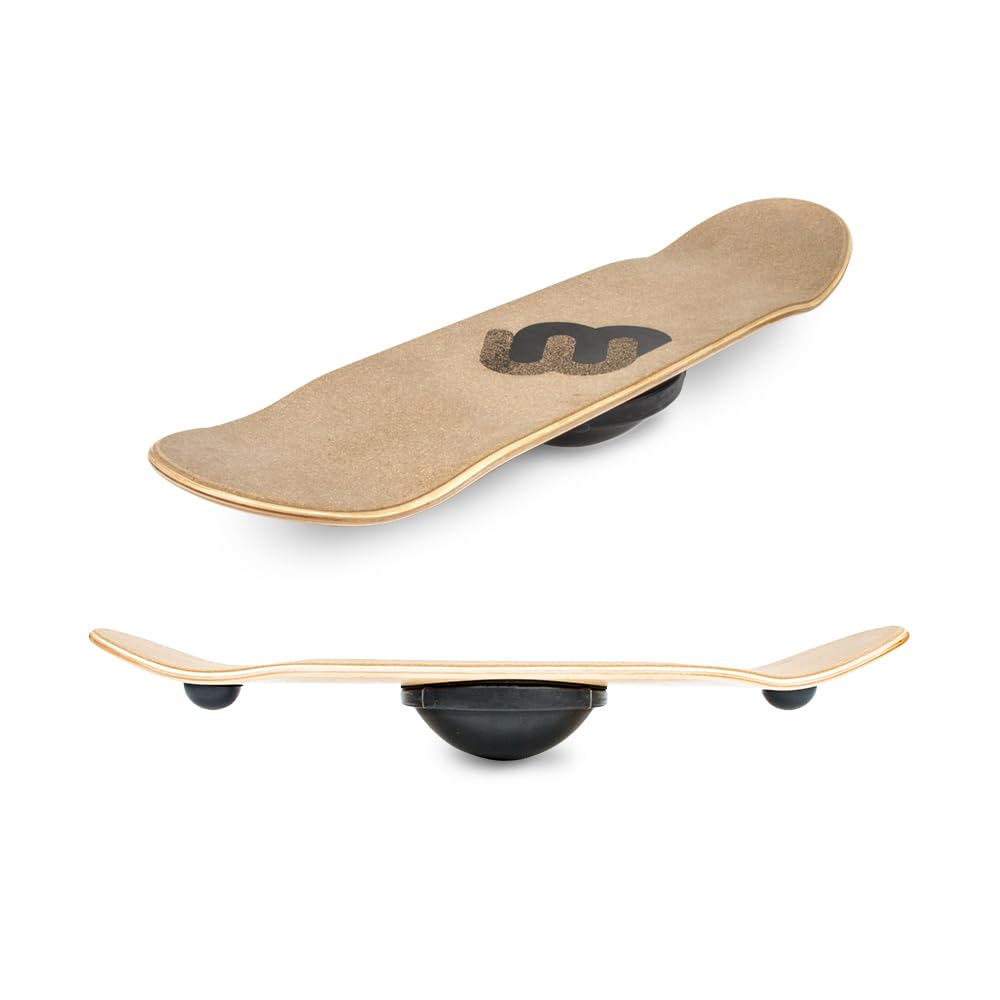
9. Whirly Board Spinning Balance Board
A 360-degree spinner that trains your hips, core, and hockey agility
This isn’t a wobble board — it’s a spinning board. The Whirly Board sits on a ball and rotates a full 360 degrees, engaging your hips and thighs in a way nothing else here can. It’s built for hockey agility drills, pickleball practice, tennis footwork, and anywhere you need to pivot and react. Owners say it’s genuinely more challenging than a basic wobble board.
The construction is top-tier US workmanship. It’s made in Northern Wisconsin from premium 7-ply Canadian maple, with high-traction grip tape and a cork rubber surface. It supports up to 400 pounds and carries a lifetime replacement promise — the kind of confidence you don’t see from budget boards. One owner progressed from a 3-second balance to 30-60 seconds within a week, and another uses it at a standing desk to prevent stiff knees.
It’s a phenomenal tool, but it has a clear audience. The deck is just 8.25 inches wide, which is narrow — a size 15-foot owner hit the raised perimeter lip and returned it, and a size 11-foot owner finds it uncomfortable barefoot. For most people in shoes or with average-width feet, it’s superb. Owners call it the best on the market for balance practice and build quality.
The spin advantage
- 360° rotation trains hips, pelvis, and agility, not just ankles
- 400-lb capacity with a lifetime replacement promise
- High-traction cork grip works for standing desks
Who it’s not for
- The 8.25-inch deck is too narrow for large feet — size 15+ riders should look at the wide version
- Barefoot comfort is limited; gloves or shoes recommended
Grab this for: hockey, tennis, or pickleball players who need rotational agility that a roller board simply can’t provide.
Pass on it if: you have large feet or plan to train barefoot — the narrow deck and stiff grip will be a struggle.
Understanding the Specs
Board Type: Rocker vs. Wobble vs. Roller
The board type dictates the difficulty and the muscles you train. Rocker boards tip only on one axis, making them ideal for toddlers, beginners, and gentle yoga stretching — that’s the WOOD CITY. Wobble boards tilt in every direction on a rounded base, which trains ankles and core in a 360° arc — that’s the CanDo and Fitterfirst. Roller boards sit on a cylinder and move front-to-back, closely mimicking surf or skateboarding — that’s the Indo Board, BECAPRO, and XCMAN. If you want rotation, a spinning board like the Whirly Board is in its own category.
Weight Capacity and Deck Size
Always check the maximum weight recommendation before buying. Budget plastic boards may not list one, but quality options range from 300 to 480 pounds — the WOOD CITY holds the most at 480 lbs. Deck width matters more than length for comfort: a narrow 8-inch board (Whirly) is agile but cramped for big feet, while a wide 18-inch board (Indo) gives you room to adjust your stance. Heavier boards feel more stable but are harder to move; a 1.25-pound CanDo is portable, but a 13.8-pound Indo Board is a permanent fixture.
FAQ
What is the difference between a roller board and a wobble board?
Can I use a balance board at a standing desk?
Will a balance board help with ankle rehab after an injury?
How much weight can these balance boards actually hold?
Is it safe to use a balance board barefoot?
What is the best balance board for a beginner?
How long does it take to see results from balance training?
Can a balance board double as a kids’ toy?
Do these boards scratch or damage hardwood floors?
Final Thoughts: The Verdict
For most buyers, the yoga balance board winner is the Indo Board because it pairs an class-leading 4.9-star reputation across 900+ owners with the versatility to train surf, core, and family fitness on one beautiful maple deck. If you want a compact wobble board that makes standing-desk work feel like a workout, grab the StrongTek. And for a family with kids of all ages, the WOOD CITY rocker is the one to reach for — it’s the rare balance tool that entertains and trains at the same time. The crowd favorite in this space holds the higher score, so start there if you want the definitive experience.
How We Picked
We do not accept paid placement. Every pick is matched to a real buyer and a real use-case; we do not hands-on test units.
Sources & Methodology
Specifications: manufacturer listings and product documentation. Review insights: verified customer reviews, as of August 2026. Pricing: not shown on this page (it changes often); check the current price via the retailer link.