
Specs are compiled from manufacturer listings and verified buyer reviews and can change over time — please confirm the key details on the product page before buying.
If you are shopping for wrist equipment exercisers, you likely want one of two things: stronger forearms for climbing, lifting, or guitar, or a safe way to rebuild strength after a wrist or hand injury. The best tools for both goals are small, affordable, and easy to use at a desk, on the couch, or at the gym. This guide breaks down the top performers so you can match the right tool to your specific goal, whether that is progressive resistance, finger isolation, or rehabilitation flexibility.
I’m Maruf — the founder and writer behind HomeYarr. This guide is built by comparing the manufacturers’ published specifications and the patterns across verified customer reviews, so you get each pick’s real strengths and trade-offs instead of marketing spin.
Your search for the wrist equipment exerciser ends here with a clear breakdown of the top-rated grip trainers and therapy bars on the market today.
Our Picks at a Glance


How To Choose The Best Wrist Equipment Exerciser
Before picking a wrist exerciser, decide what “strong” means for you. A rock climber needs crushing grip endurance, a guitarist needs finger dexterity, and someone in physical therapy needs gentle, controlled movement. Each tool in this guide targets a different muscle group, so the right choice depends on your daily pain points and your goals.
Match the Tool to the Muscle
A hand gripper works the muscles that close your fingers, while a finger stretcher works the ones that open them. A wrist roller, on the other hand, forces your entire forearm to stabilize as you roll a weighted strap up and down. If you want balanced strength, look for a kit that includes both a gripper and a stretcher. If your focus is elbow pain from tennis or golf, a flex bar that you twist and bend is the better fit because it loads the forearm tendons through a full range of motion.
Resistance Range is the Real Spec
Ignore the number of pieces in a box and look at the tension spread instead. A good kit lets you start light and progress without buying a second tool. Some adjustable grippers span a wide range, like 5-100KG on the Hiyoga, while multi-piece sets offer discrete steps. For rehab, you want a light starting point, such as the 0.75lb to 9lb range on the Prohands, so you are not fighting too much resistance while your tendons heal. For strength, look for a top end that challenges you, ideally above 132lbs if you already have solid grip strength.
Quick Comparison
| Model | Best For | Resistance Range | Number of Tools | Weight | Amazon |
|---|---|---|---|---|---|
| Forearm Wrist Roller Blaster★ Best Overall | Heavy forearm loading | Up to 330 lbs | 1 | 0.86 kg | Amazon |
| 13 PCS Grip Strength Trainer KitBest Value | Full hand rehab variety | 4 lbs to 132 lbs | 13 | — | Amazon |
| FitBeast Grip Strength TrainerRehab to Strength | Rehab to strength stepping | 10-60LB rings | 6 | 0.54 kg | Amazon |
| Hand Grip Strengthener Kit 5 Pack | Tracked adjustable training | 5-60kg | 5 | 0.41 kg | Amazon |
| Hiyoga Grip Strength Trainer | Auto-counted workouts | 5-100KG | 1 | 6.56 oz | Amazon |
| Prohands Gripmaster | Individual finger isolation | 0.75lb to 9lb | 1 | 2.24 oz | Amazon |
| Logest Twist Hand Exerciser Bars | Elbow tendon therapy | X-Light to Heavy | 4 | 1.94 kg | Amazon |
| DICYWUDI Flex Therapy Bar | Progressive elbow rehab | 5LB to 25LB | 4 | 1.25 kg | Amazon |
In-Depth Reviews
1. Forearm Wrist Roller Blaster Exerciser
Our pick — over 4.5★ from 800+ verified ratings; the strongest balance of quality and price.
The classic loaded roller that builds serious forearm mass with just a steel pipe and a strap.
If you want the kind of forearm development you can feel in your sleeve, this roller is the real deal. You attach a standard weight plate, roll it up and down with your wrists, and let the constant tension exhaust your forearms in a way squeezing a gripper never will. The loading pin accepts all 1-inch standard weight plates and supports up to 330lbs, so you can progress from a light 10lb plate to something genuinely heavy as you get stronger.
The handle is built from a sturdy steel pipe with an EVA outside layer, which keeps your hands comfortable during high-rep sets and gives you a firmer grip even when your palms start sweating. Buyers report it is remarkably effective with higher rep counts, and the combination of rolling plus grip work makes for a great full forearm workout. The nylon strap holds up under repeated use with heavy plates, though a few owners mention the carabiner runs small and the strap can snag on rack edges, so give it a quick check before loading it up.
What makes this the best overall pick is its unique role in your routine: it does something no gripper or ring can do, building forearm endurance through an extended range of motion. At 0.86 kg it is heavier than the FitBeast’s 0.54 kg, but that weight is exactly what allows it to take on real plates. The crowd consensus backs this up — it holds a 4.7-star rating with 800+ owners, making it the highest-rated and most-reviewed pick in this guide.
Why lifters love it
- Supports up to 330lbs on a 1-inch standard weight plate pin
- Steel pipe handle with EVA padding reduces hand fatigue
- Owners rate effectiveness as the top reason to buy
Things to watch
- The carabiner is small, so check it fits your rack setup
- Strap can snag on edges during fast sets
Your move: This is for anyone who wants measurable forearm growth and already owns standard weight plates.
Reality check: You need a plate to use it, so if you train at a gym, it is a bag item rather than a desk tool.
2. 13 PCS Grip Strength Trainer Kit
A complete rehab arsenal that covers every finger and muscle from light stretching to heavy crushing.
This 13-piece kit is the most comprehensive set here, and it is the one to grab if you are recovering from an injury or want to cover every angle of hand health. It includes an adjustable smart-counting hand exerciser (11lbs to 132lbs), an adjustable finger stretcher with 6 levels, a finger exerciser at 4lbs per finger, three stress relief balls at 15, 25, and 30lbs, three forearm workout rings at 30, 40, and 50lbs, and three finger stretchers at 6.6, 8.8, and 11lbs. That spread means you can start almost painlessly and climb to a serious challenge.
The quality across all 13 pieces is what owners praise most, with the kit’s construction earning the top mention count. Owners mention it is exactly what they needed after breaking a wrist in three places, and parents note it helped kids build handwriting stamina without feeling like therapy. The textured, non-slip rubber handles fit a wide range of hand sizes, and the whole set packs small enough for a desk drawer or travel bag.
But for the price and sheer versatility, this kit delivers more usable tools than anything else in the lineup, with quality and effectiveness both ranking as top positive aspects among owners.
Versatility winner: No other pick gives you 13 distinct tools spanning recovery and strength in one compact, affordable kit.
Who it fits: Post-injury recovery, seniors rebuilding hand function, and beginners wanting a full toolkit without separate purchases.
3. FitBeast Grip Strength Trainer
Clever dual-resistance rings that give you two workouts from a single squeeze.
The FitBeast kit takes a smart approach to progression: each ring offers two resistance levels depending on how you squeeze it, like 30LB versus 40LB, so you get double the value from one tool. The set pairs three grip rings spanning 10-60LB with three stress balls rated Soft, Medium, and Hard, giving you a clear stepping path from gentle rehab to real strength work without switching equipment.
What wins people over is the variety of pressures available — customers note there are so many different levels to work with that hand strength comes back faster than expected, and musicians specifically praise it for building the finger strength needed for bar chords. The durable TPE and lycra construction with textured surfaces keeps a grip even with sweaty hands, and at 0.54 kg it is much lighter and more portable than the Forearm Wrist Roller’s 0.86 kg, making it an easy bag or desk-drawer companion.
The one honest knock is presentation, not function: a few owners received the set with stained packaging or a broken seal, though nothing was missing or contaminated. The recurring recommendation is to swap the included bag for a cloth drawstring pouch. The set holds a 4.5-star rating across 580 buyers, and the strength progression from rehab to routine is exactly what its owners value most.
Smart design wins
- Dual-resistance rings deliver 30LB vs 40LB from one squeeze
- Three stress ball firmness levels for gradual growth
- Non-slip TPE and lycra grip works when hands are sweaty
Minor trade-offs
- Some units arrive with stained or broken packaging
- The included bag tears easily, worth replacing
Pick this if: You want a simple, portable progression system from post-injury recovery to daily strength maintenance.
Look elsewhere if: You need heavy top-end resistance beyond 60LB for advanced grip training.
4. Hand Grip Strengthener Kit 5 Pack

The counter-equipped kit that turns grip training into trackable progress you can measure.
If you like seeing your numbers improve, this 5-pack puts a built-in counter on its main gripper so you can record every rep across a 5-60kg adjustable resistance range. The ergonomic, non-slip textured handle fits all palm sizes, and the adjustable tension means you can warm up light or grind out heavy sets without changing tools. It replaces the old single fixed-strength gripper by letting you log visible strength improvement over time.
Beyond the counter gripper, the kit includes a 4-gear finger stretcher with a wrist fixing strap to stop slipping, plus a silicone grip ring and textured stress ball for a full hand and forearm workout. Owners love the versatility for different exercises, and those with large hands report the adjustable design works well even for XL sizes. The set ships in a compact drawstring storage pouch that fits easily into a gym bag, office drawer, or car.
The honest caveat is that this kit targets rehab and general conditioning rather than heavy strength work. One owner notes that if you already have solid upper-body strength and train regularly, the resistance may not challenge you much. It is best for people rebuilding after an injury, office workers relieving wrist soreness, and beginners establishing a routine. At 0.41 kg, it is the lightest multi-tool kit here, and owners rate quality and grip strength as the standout positives.
Progress tracker: The built-in counter separates this from every other kit, turning vague effort into measurable rep counts.
Fit note: Ideal for rehab, desk breaks, and beginners — not for advanced lifters chasing heavy single reps.
5. Hiyoga Grip Strength Trainer
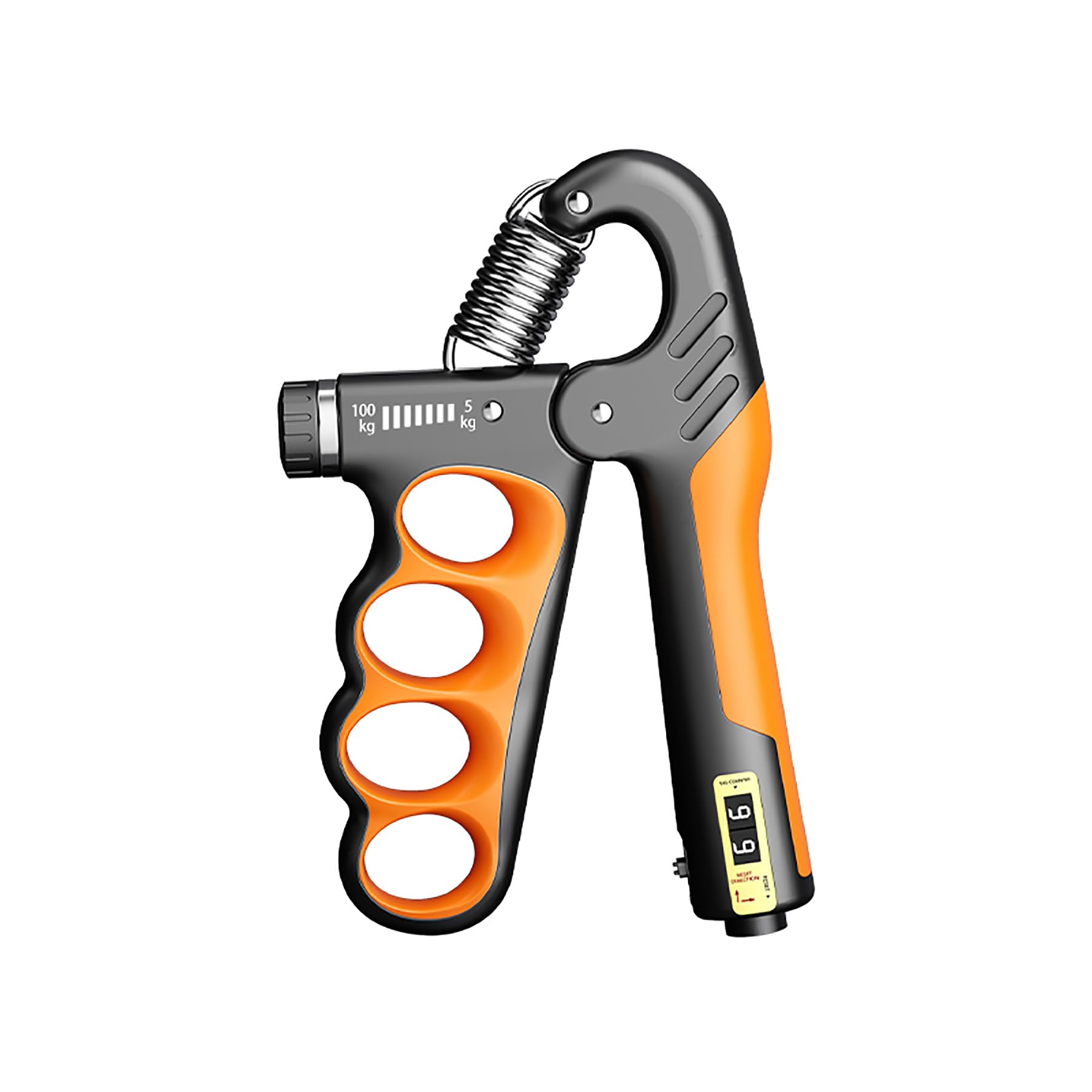
The single adjustable gripper with a built-in counter that tracks every rep automatically.
For a focused, no-nonsense gripper, this Hiyoga model packs an automatic counter that records your reps as you squeeze, reset easily by rotating the button. The resistance adjusts across a 5-100KG range, which suits everyone from a beginner to a seasoned lifter. If you train at a desk, the counter means you can set a daily rep target and hit it without keeping a tally in your head.
The high-strength stainless steel spring is built to resist rust and survive heavy use, while the TPR handle provides a comfortable, anti-slip grip that fits various hand sizes. Its knuckle-duster handle design prevents fingers from slipping off during intense sets, a detail owners specifically call out. At 6.56 ounces, it is one of the lightest single grippers here and disappears into a pocket or desk drawer.
The catch is that the lowest resistance setting is heavier than advertised — shoppers say it starts around 15-20lbs minimum rather than the stated 5kg floor, so it is not a true entry-level rehab tool for very weak hands. The counter also feels a bit cheap and clicky, and resistance levels are unmarked. It holds a 4.3-star rating across 796 buyers, with quality and effectiveness as the most-mentioned positives, making it the best pick for intermediates wanting to track progress.
Tracker advantage: The auto counter and wide 5-100KG range make this the best choice for data-driven grip training.
Know before buying: The lightest setting runs heavier than the spec suggests, so it suits intermediates more than rehab beginners.
6. Prohands Gripmaster

The original finger-by-finger trainer that stops strong fingers from cheating for weak ones.
If your grip feels uneven or one weak finger is holding you back, the Prohands Gripmaster is the tool that fixes it. Each finger gets its own spring, so your stronger digits cannot compensate for a weaker one — working each finger individually builds balanced strength, dexterity, and endurance across your entire hand. The graduated tension spans 0.75lb to 9lb, making it an excellent starting point for rehab or a precise tool for musicians who need fine control.
It is built from high-quality components: ABS plastic, stainless steel springs, and approved santoprene for the grip. The individual finger springs even out grip imbalances, and the ergonomic palm handle fits large hands comfortably. It is used by professional athletes and world-class musicians, though that reputation is earned through the design rather than any endorsement. At just 2.24 ounces, it is the lightest single trainer here and fits easily in a pocket or small bag.
Because the range tops out at 9lb, this is not a tool for heavy forearm mass — it is a precision instrument for finger strength, dexterity, and therapy. Owners recovering from hand injuries report it is excellent for rebuilding grip after trauma, and the ability to buy different tension models means you can progress as you heal. It holds a 4.6-star rating across 414 buyers, with effectiveness as the standout positive.
Why specialists choose it
- Individual finger springs prevent strong fingers from compensating
- Stainless steel springs last through heavy daily use
- Ultra-light 2.24 oz design travels easily
Limits to know
- Maxes out at 9lb, so it is not for heavy forearm building
- Focused on fingers rather than full-hand crushing power
Grab this for: Musicians, climbers, and anyone in rehab who needs precise, balanced finger strength.
Pass if: You want maximum forearm loading — the wrist roller is the better tool for that.
7. Logest Twist Hand Exerciser Bars

Twist-and-bend bars that load the elbow tendons through a full range of motion.
Unlike grippers that only work your fingers, these Logest bars are designed for a twisting and bending motion that targets the tendons around the elbow, wrist, and forearm. The 4-piece set includes three color-coded resistance bars — a light green, medium blue, and heavy red — plus an instruction manual, so you can start gently and progress at your own pace. This is the tool to reach for if tennis elbow, golfer’s elbow, or general tendon tightness is your main complaint.
They are crafted from strong yet flexible thermoplastic rubber with a rigid design that provides an easy grip during exercise. Owners in physical therapy report these are similar to the bars used at their occupational therapist’s clinic, and the set offers a sensible range of resistance for rehab needs. They are portable enough to use at home, the office, or while traveling, turning downtime into productive therapy sessions.
The honest trade-off is that the two heaviest bars can feel too aggressive for occupational therapy settings — at least one owner’s therapist recommended sticking to only the first two bars. If you are recovering from a serious elbow injury, start with the lightest bar and check with your therapist before progressing. It holds a 4.6-star rating across 502 buyers, with quality and effectiveness as the top positives.
Therapy match: The twisting motion targets elbow and forearm tendons in a way no gripper can, making it ideal for tendonitis relief.
Pace yourself: The two heavier bars may be too much for early rehab, so progress slowly and follow your therapist’s guidance.
8. DICYWUDI Flex Therapy Bar

A clearly labeled four-level flex bar set that takes you from extra-light to hard resistance.
This DICYWUDI set makes progressive elbow and wrist therapy simple by color-coding each bar: Yellow at 5LB for extra-light, Red at 10LB for light, Green at 15LB for medium, and Blue at 25LB for hard. That clear ladder lets you start gently and climb to heavier resistance as your tendons adapt, making it a favorite among people working through tennis elbow, golfer’s elbow, and tendonitis. The bars are made from durable thermoplastic elastomers that flex and bend through a full range of motion.
What owners appreciate most is the quality and effectiveness during physical therapy — one buyer’s occupational therapist specifically recommended this style of bar for strengthening wrists and hands. The set even includes a carry bag, making it easy to bring to therapy sessions or use at home. Buyers report noticeable progress, with some advancing from the 10LB to the 15LB bar within two months of consistent use.
The only minor complaint is that the textured grip can cause mild skin redness during longer sessions, so listen to your hands and take breaks. At 1.25 kg, the set is substantial but still portable, and it is lighter than the Logest’s 1.94 kg while offering more clearly defined resistance steps. It holds a 4.7-star rating across 571 buyers, the highest score on this list alongside the wrist roller, with quality as the most-praised aspect.
Clear progression
- Four labeled resistance levels from 5LB to 25LB
- Includes a carry bag for therapy trips and travel
- Owners rate quality and effectiveness as standout strengths
Minor note
- Textured grip may cause mild redness during long sessions
- Set is heavy enough that it is a bag item, not a pocket tool
Best for: People who want a clear, measured path through elbow and wrist rehab with defined resistance steps.
Choose Logest instead if: You prefer a lighter starting point and a softer initial bar for very early recovery.
Understanding the Specs
Resistance Range
This is the single most important number on any wrist exerciser. It tells you the starting difficulty and the ceiling you can grow into. For rehab, you want a low floor, like the 0.75lb start on the Prohands or the 5LB start on the DICYWUDI. For strength, focus on the top end, such as the 330lbs supported by the wrist roller or the 132lbs max on the adjustable grippers. A wider range means you can progress without buying a second tool, which is why adjustable models are often better value than fixed-resistance single pieces.
Tool Count vs. Coverage
A 13-piece kit sounds better than a 4-piece set, but what matters is which muscles each piece works. A complete hand routine covers four actions: crushing (grippers), pinching (stress balls), stretching (finger stretchers), and twisting (flex bars). The 13-piece Navona kit covers all four, while the Logest and DICYWUDI sets focus entirely on twisting. If you only want to address elbow pain, a 4-bar set is enough. If you want full hand health, look for a kit that includes both a gripper and a finger stretcher to avoid muscle imbalance.
FAQ
What is the difference between a grip trainer and a flex bar?
How much resistance should I start with for wrist rehab?
Will a wrist exerciser help with carpal tunnel syndrome?
How long should I use a grip trainer each day?
Can I build visible forearm muscle with these tools?
Are adjustable grippers better than fixed-resistance ones?
What does “finger isolation” mean and why does it matter?
How do I know which resistance level is right for me?
Can I take these tools to the gym or office?
Why do some kits include a finger stretcher?
Final Thoughts: The Verdict
For most people, the wrist equipment exerciser winner is the Forearm Wrist Roller Blaster because it delivers the most dramatic forearm development by loading real weight plates through an extended range of motion. If you are recovering from an injury and want the most complete toolset, grab the 13 PCS Grip Strength Trainer Kit for its class-leading variety. And if specific finger strength for music or climbing is your goal, the Prohands Gripmaster is the one to reach for, with its individual finger springs that stop stronger digits from covering for weaker ones.
How We Picked
We do not accept paid placement. Every pick is matched to a real buyer and a real use-case; we do not hands-on test units.
Sources & Methodology
Specifications: manufacturer listings and product documentation. Review insights: verified customer reviews, as of August 2026. Pricing: not shown on this page (it changes often); check the current price via the retailer link.