
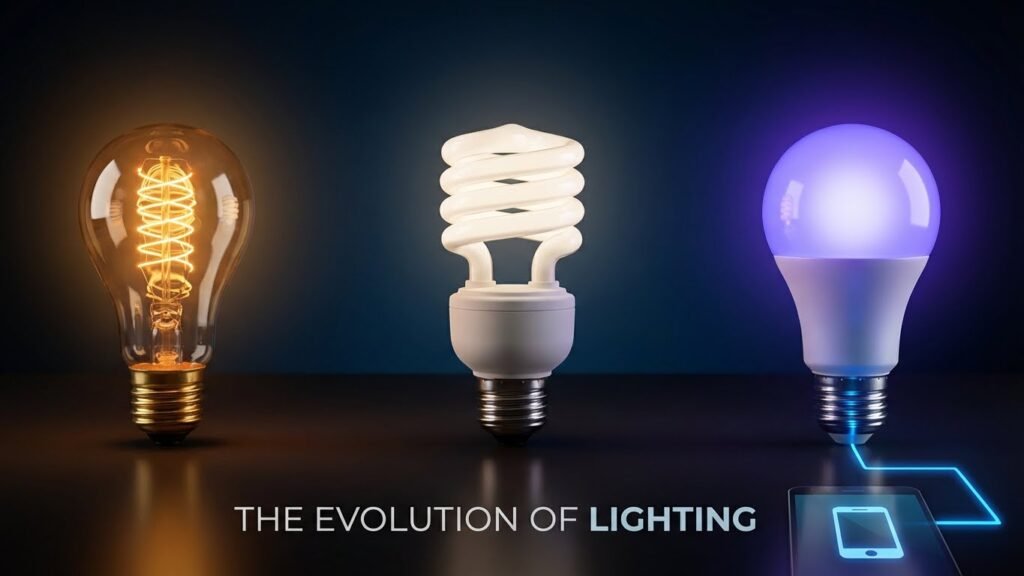
You might think smart bulbs sprang up overnight, but they evolved over decades from timers, dimmers, and early networked lighting. The first consumer smart bulb line that looks like what you buy today launched in 2012 with Philips Hue, though earlier prototypes and concept devices appeared in the 1990s and research labs before that.
If you want to know how smart bulbs moved from lab ideas to devices you control with your phone, this post will trace the key steps. You’ll see which inventions mattered, how home automation pushed the market, and what makes today’s bulbs truly “smart.”
Key Takeaways
- Smart bulbs reached consumers in a recognizable form in 2012 with mainstream products.
- Earlier concepts and prototypes set technical groundwork decades before mass-market launch.
- Home networks and LED advances made modern smart lighting practical and popular.
The Invention of the Smart Light Bulb

Smart bulbs started as simple upgrades to electric lamps: adding dimmers, timers, and remote control. Over decades they gained wireless radios, microcontrollers, and LEDs that let you change color and schedule lighting from your phone.
Timeline of Smart Light Bulb Development
You can track smart bulb progress in clear steps.
- 1870s–1900s: Electric lamps and practical incandescent bulbs made indoor electric lighting common.
- Mid 20th century: Dimmers and timers appeared, giving basic control over brightness and schedules.
- 1980s–1990s: Short-range wireless protocols like early radio and later Bluetooth were developed, enabling remote control ideas.
- 2000s: LEDs became efficient and affordable, which mattered because LEDs tolerate electronic control better than incandescents.
- 2010s: Companies combined LEDs, Wi‑Fi or Zigbee radios, and embedded software to make bulbs controllable via apps and smart hubs.
This sequence shows how hardware, networking, and LEDs had to mature before true smart bulbs emerged.
Key Inventors and Innovators
You’ll find no single inventor of the smart bulb. It grew from many contributions.
Thomas Edison and others made electric lighting practical, but later engineers added electronic control, compact LEDs, and wireless chips.
Companies such as Philips, Cree, and startups like Belkin (WeMo) and Philips Hue teams pushed early commercial designs.
Standards groups and chipmakers also shaped the field by creating Zigbee, Wi‑Fi modules, and Bluetooth Low Energy that let bulbs join home networks.
Engineers who combined efficient LEDs with small radio transceivers and firmware made the modern smart bulb possible.
First Commercial Smart Light Bulb
You can point to early 2010s products as the first widely available smart bulbs.
Philips Hue launched in 2012 as one of the first mass-market systems: LED bulbs with a Zigbee bridge and smartphone control.
Other early entrants included TCP, LIFX, and Belkin’s WeMo line, which used Wi‑Fi or bridged radios to offer app control, color changes, and scheduling.
These products moved beyond single-function dimmers by adding color tuning, scene presets, and integrations with voice assistants.
Their arrival turned smart lighting from niche demos into consumer products you can buy and install yourself.
Early Concepts and Predecessors
You will see how electric lighting, sensing ideas, and simple timers set the stage for smart bulbs. These early steps gave you key technologies: remote control, motion detection, and later LEDs with electronic drivers.
Foundation of Smart Lighting Technology
You get the foundation from three main advances: electric lighting, sensors, and digital control. Electric lighting became practical in the late 1800s with commercially usable incandescent bulbs. That gave you a reliable light source to control.
Sensors and control logic emerged much later. Motion sensors and photoelectric switches appeared in the mid-to-late 20th century and let lights respond to presence or daylight. Timers and remote controls added scheduling and off-site switching.
Semiconductors and microcontrollers in the 1970s–1990s allowed cheap electronic circuits that could process inputs and switch power. Those parts let manufacturers add programmability and simple logic to lighting systems, which you now recognize as the core of “smart” behavior.
Evolution from Traditional Bulbs
Traditional bulbs evolved from filament lamps to fluorescent tubes, then to LEDs. Incandescent bulbs dominated early lighting because they were simple and reliable. Fluorescent lamps improved efficiency and introduced electronic ballast circuits that hinted at more complex control needs.
LEDs changed the game. They use low-voltage drivers and are easy to dim or modulate. That electrical flexibility made dense control and communication possible. You found that manufacturers could add small electronic modules to LEDs without major rewiring.
Mechanical timers and photocells were early user-facing controls. They automated on/off tasks, but did not change light quality. The shift to LED plus electronics allowed both automation and control of brightness, color, and efficiency in one package.
Milestones in Lighting Automation
Key milestones mark how automation reached consumer lighting. First, mechanical timers and photocells automated on/off schedules for outdoor lights. Next, motion sensors became common in security and utility lighting, responding directly to movement.
Later, digital controllers and building automation systems in the 1980s–2000s introduced centralized scheduling and scene control in offices and commercial buildings. Wireless protocols such as Zigbee and Z-Wave arrived in the 2000s, letting lamps exchange commands without new wiring.
By the 2010s, compact LEDs, cheap microcontrollers, and wireless radios converged. You could buy bulbs that combine dimming electronics, sensors, and Wi‑Fi or mesh radios. Those bulbs turned a light source into an addressable device on your home network.
Rise of Home Automation and Smart Lighting
Smart light bulbs became useful parts of whole-home systems by linking lighting to timers, motion sensors, and voice control. You can now change brightness, color, and schedules from one app or a voice assistant. This shift made lighting a programmable, networked service rather than a separate gadget.
Integration with Smart Home Systems
You control smart bulbs through hubs, apps, or voice assistants like Alexa and Google Assistant. Many bulbs use a hub or bridge to join a home network, letting you group lights, set scenes, and trigger routines with one command.
Integration means bulbs follow rules you set. For example, lights can turn on when a door sensor opens, dim at sunset, or flash on a security alarm. You manage those behaviors from a central app or automation platform, so the system acts together instead of individual devices.
Compatibility matters. Look for bulbs that support common platforms (Zigbee, Matter, or major voice assistants) so your lights work with smart locks, thermostats, and sensors without extra adapters.
Advancements in Wireless Communication
Wireless tech made smart bulbs reliable and easy to install. Early systems relied on wired controls or proprietary radio. Today most bulbs use Wi‑Fi, Bluetooth, Zigbee, or Thread to connect.
Wi‑Fi gives direct internet access and easy setup but can overload your router if you add many bulbs. Bluetooth pairs quickly but often needs a phone nearby. Mesh protocols like Zigbee and Thread let devices forward signals, improving range and stability across a home.
New standards such as Matter aim to simplify device pairing and cross‑brand work. With Matter, you can expect fewer setup steps and more predictable behavior when mixing bulbs from different manufacturers.
Smart Light Bulbs in the Modern Era
Smart bulbs now connect to phones, voice assistants, and home hubs. They offer color control, scheduling, energy savings, and integrations with security and automation systems.
Notable Product Launches
Philips Hue (2012) brought Zigbee-based color bulbs to mainstream consumers and made multi-bulb systems easy to control with a bridge. You could set rooms, scenes, and schedules from an app, which pushed other makers to follow.
LIFX (2012 Kickstarter) shipped Wi‑Fi bulbs that did not need a bridge and offered high brightness and saturated color options. You get direct cloud control and strong marketing around vivid scenes.
Later entries like Sengled, Wyze, and IKEA introduced lower-cost options and BLE or Matter compatibility. These products focused on price, reliability, or open standards so you can mix brands in larger smart-home setups.
Technological Improvements Since Inception
LED efficiency improved power use while increasing brightness and color accuracy. You benefit from bulbs that use a fraction of the energy of old incandescents and still deliver 800–1,000 lumens on 8–15 watts.
Connectivity moved from Zigbee-only ecosystems to Wi‑Fi, Bluetooth, Thread, and Matter support. That means you can control bulbs directly, through hubs, or with voice assistants like Alexa, Google, or Siri.
Software features grew too: adaptive scheduling, daylight-aware color temperature, scenes, and integrations with alarms and cameras. These features let you automate lighting based on time, presence, or security events for safety and comfort.
Impact on Daily Life and Industry

Smart bulbs changed how you control light and how businesses manage lighting. They let you schedule, dim, and monitor energy use from apps or voice assistants. This section explains how adoption looks in homes and businesses and how smart bulbs affect energy efficiency.
Adoption in Homes and Businesses
You can replace many standard bulbs with smart LED bulbs that connect to Wi‑Fi or a hub. In homes, people use apps to set schedules, sync lights with sunrise/sunset, and create scenes for activities like reading or movie night. Smart bulbs also integrate with voice assistants so you can control lighting hands‑free.
Businesses use smart lighting for offices, retail, and warehouses. You can program lights to save power during off hours, adjust color temperature to improve worker alertness, and link lighting to occupancy sensors. Property managers often deploy centralized dashboards to monitor hundreds of fixtures across buildings.
Key benefits you will notice: easier control, fewer manual switches, and lighting tailored to tasks. Initial purchase costs vary, but many find payback comes from reduced labor and better energy management.
Influence on Energy Efficiency
Smart bulbs use LED technology that already cuts energy use by up to 80% compared with old incandescent bulbs. On top of that, you can set schedules, use motion sensors, and dim lights to lower consumption further. For example, programming lights to turn off automatically in empty rooms directly reduces wasted electricity.
You can also track usage with apps or building management systems to spot savings opportunities. Businesses often see measurable drops in monthly energy bills after optimizing schedules and using sensors. In homes, combining smart bulbs with smart plugs and thermostats gives you coordinated energy savings across devices.
Keep in mind that total savings depend on how you use the system, your local electricity rates, and the number of fixtures replaced.
Future Perspectives in Smart Lighting
You will see smart lighting become more connected and context-aware. Devices will share data with home systems, sensors, and even city infrastructure to match light to activity, time, and weather.
Expect stronger focus on energy and sustainability. Smart bulbs and fixtures will use less power and work with building systems to reduce waste. You can track energy use in real time and adjust settings automatically.
Privacy and security will matter more as devices share more data. You should look for products with strong encryption and clear data policies. Manufacturers will face pressure to follow stricter standards.
New communication methods will expand capability. Visible light communication and improved mesh networks can offer faster, local data links. That can let your lights carry both illumination and short-range data services.
You will get more customization and accessibility features. Adaptive lighting that supports sleep cycles, mood, and visual needs will become standard. Integration with voice and automation will make control easier for everyone.
Key trends at a glance:
- Smart energy management and grid interaction
- Enhanced privacy and device security
- Visible light communication and better mesh networking
- Personalization for health and accessibility
You should evaluate smart lighting by interoperability, security, and energy benefits. Choose products that fit your ecosystem and offer firmware updates to keep your system safe and useful.
FAQs
What counts as the first smart light bulb?
Definitions vary. You can call early networked and remotely controlled lamps “smart” when they add timers, dimming, or remote control. Modern smart bulbs typically use LEDs and connect by Wi‑Fi, Bluetooth, or Zigbee.
When was the first smart bulb made?
You can trace smart-bulb ideas to the 1990s when companies tested connected lighting. Widespread consumer smart bulbs appeared in the 2010s after LEDs became cheap and wireless standards matured.
How do smart bulbs work?
Smart bulbs contain LEDs, a driver, and a wireless module. You control them with an app, voice assistant, or hub. They often support color change, scheduling, and automation.
Are smart bulbs more efficient than old bulbs?
Yes. LEDs use much less energy than incandescent bulbs. Smart features can cut energy use further by scheduling and sensors.
Will my smart bulbs still work in 10 years?
That depends on the product and support. Hardware can last many years, but software, app support, and cloud services may change. You can favor bulbs with local-control options for longer useful life.
Do smart bulbs need hubs?
Some do, some don’t. Many modern bulbs connect directly to Wi‑Fi or Bluetooth. Others use Zigbee or Z‑Wave and require a hub or bridge for full functionality.
Conclusion
You can trace the smart light bulb to gradual advances rather than a single invention. Early electric bulbs gave light; later electronics, timers, and network tech added control. By the 2000s and 2010s, LED efficiency and wireless standards let smart bulbs become practical for homes.
Expectations and uses changed as technology improved. You now get bulbs that dim, change color, and connect to phones or voice assistants. Major standards like Wi‑Fi, Zigbee, and Bluetooth made that connectivity reliable.
If you want deeper technical background, read device networking guides from the Zigbee Alliance or wireless-overview pages at IEEE for standards and timelines. Those sources explain how networking and power efficiency shaped smart lighting.
Your choice of smart bulb depends on what you need: simple remote control, full home automation, or energy savings. Look for open standards and security updates so your devices stay useful and safe.