
Specs are compiled from manufacturer listings and verified buyer reviews and can change over time — please confirm the key details on the product page before buying.
When you’re choosing a serious desktop amp, “balanced” is a buzzword you’ll hear often. But what matters is whether the amp’s core—its power supply, circuit design, and output stage—truly feeds a balanced headphone correctly, or just has the right connector on the back. Mid-range and premium models now deliver enough current and voltage to drive both sensitive in-ear monitors and power-hungry planar headphones. This guide separates genuine balanced circuits from amps that merely add an XLR jack.
I’m Maruf — the founder and writer behind HomeYarr. This guide is built by comparing the manufacturers’ published specifications and the patterns across verified customer reviews, so you get each pick’s real strengths and trade-offs instead of marketing spin.
From the compact value champ to the 17,000mW desktop beast, these are the best xlr headphone amplifier options for turning your wired headphones into a high-fidelity listening station.
Our Picks at a Glance

How To Choose The Best XLR Headphone Amplifier
Start with your headphone’s impedance and sensitivity, then match the amp’s power delivery to those needs. A high-impedance pair like the Sennheiser HD 650 needs a lot of voltage, while a low-impedance planar magnetic headphone needs a lot of current (measured in milliwatts). Matching power delivery to impedance ensures headroom for dynamic peaks instead of a thin, strained sound.
Balanced Output Isn’t Just a Bigger Jack
A true balanced amp uses a differential circuit from input to output, doubling voltage swing and canceling common-mode noise. This is why amps like the Apos Gremlin and Topping L70 offer 4-pin XLR and 4.4mm balanced outputs alongside the standard 6.35mm single-ended jack. If you only have a single-ended headphone, a balanced amp will still drive it perfectly well—the circuit just uses half of its architecture.
Power Ratings: mW Means Nothing Without Impedance
You’ll see specs like “2400mW” or “1250mW” listed prominently, but these numbers are meaningless without knowing the impedance they were measured at. A rating of 1250mW at 32 ohms is a different beast from 1250mW at 300 ohms. High-impedance headphones need high voltage, so look for amps that state power at both low (32Ω) and high (300Ω) loads. The Fosi Audio ZH3, for example, lists its power at 32Ω specifically to show it has the current to drive modern planars and low-impedance dynamics.
Solid-State vs. Tube: The Sound Signature
Solid-state amps like the Topping L70 use transistors to amplify the signal with ultra-low distortion and a dead-silent noise floor, making them ideal for analytical listening and sensitive in-ear monitors. Tube amps, or hybrid amps like the Apos Gremlin, introduce a vacuum tube in the pre-amp stage to add even-order harmonics—this is the “warmth” and “musicality” you read about. Tubes soften treble and add body but need warm-up and periodic replacement; solid-state is maintenance-free.
Quick Comparison
| Model | Best For | Max Output Power | Balanced Inputs | Amplifier Type | Amazon |
|---|---|---|---|---|---|
| FiiO K13 R2R★ Best Overall | R2R DAC warmth with Bluetooth | 2400mW | XLR (Output) | Solid-State (R2R DAC) | Amazon |
| S.M.S.L M300SEBest Value | Budget MQA decoding | — | XLR (Output) | Solid-State (CS43131) | Amazon |
| Apos GremlinTube Delight | Tube warmth on a budget | 1250mW | XLR & RCA | Hybrid Tube (12AU7) | Amazon |
| Fosi Audio ZH3 | Versatile all-in-one desktop | 2570mW @32Ω | RCA (Input) | Solid-State (AKM4493SEQ) | Amazon |
| Douk Audio E2 | Vintage tube preamp + amp | 2000mW | XLR (Input) | Hybrid Tube (Valvo ECF801) | Amazon |
| Topping L70 | Pure balanced solid-state power | 7500mW x2 | XLR & RCA | Solid-State (NFCA) | Amazon |
| HIFIMAN EF499 | R2R sound with streaming | 4.35W Balanced | XLR (Output) | Solid-State (R2R) | Amazon |
| Topping DX5 II | Combo DAC/amp with PEQ | 7600mW x2 @16Ω | XLR (Output) | Solid-State (X-Hybrid) | Amazon |
| Topping A70 Pro | Extreme power for planars | 17000mW x2 | XLR & RCA | Solid-State (T’ang-ku-la) | Amazon |
In‑Depth Reviews
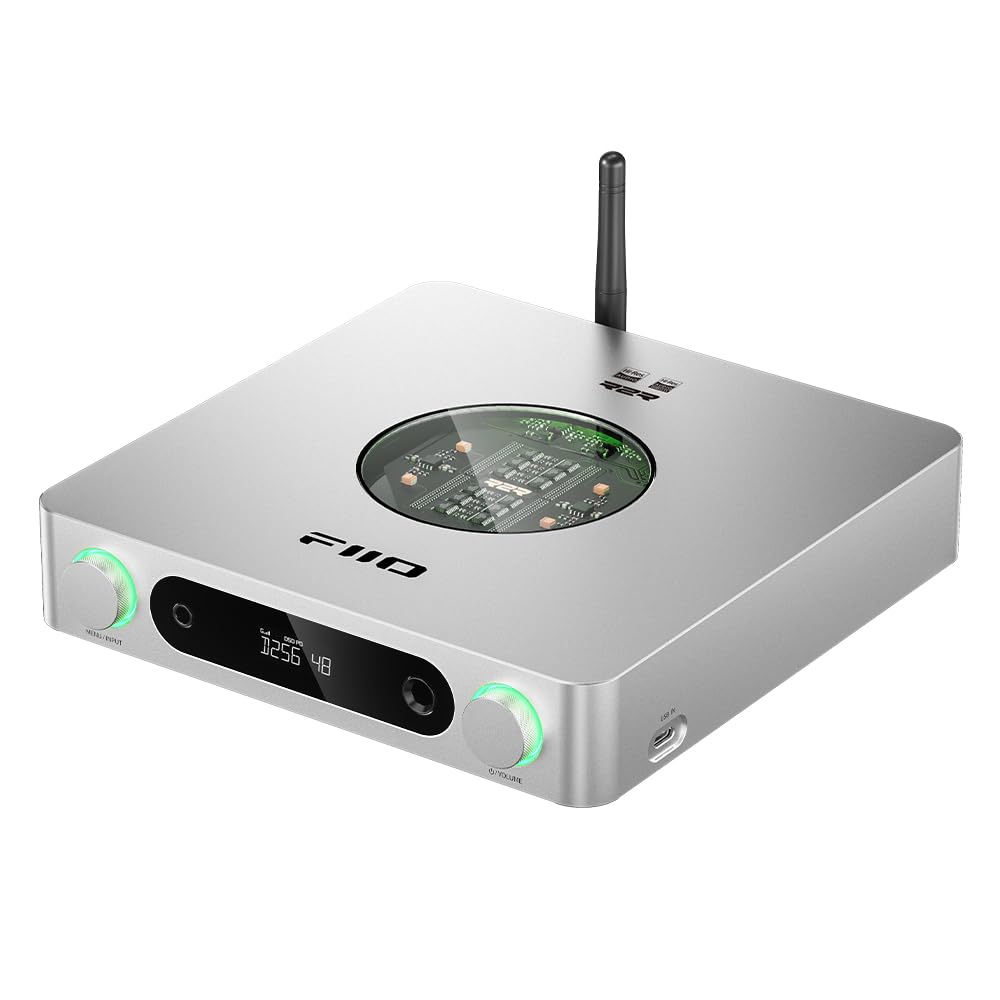
1. FiiO K13 R2R Desktop DAC & Headphone Amp
Our pick — over 4.5★ from 200+ verified ratings; the strongest balance of quality and price.
A 2400mW R2R powerhouse that wins over the crowd with its analog-like warmth and a vast feature set.
The K13 R2R pairs 2400mW of output with a warm, analog-like R2R signature. The K13 R2R uses a fully differential 24-bit R2R DAC (a digital-to-analog converter that uses precise resistors instead of a standard chip) built from 192 ultra-precise resistors. Owners consistently describe its sound as “organic” and “umami”—a warmer, more natural presentation than typical sterile DAC chips, softening transients and adding body without losing detail.
For connectivity, it’s a desktop hub. You get XLR balanced line out, dual RCA outputs, a 4.4mm balanced headphone out, and a 6.35mm single-ended out, alongside PCM 384kHz/32bit and DSD256 decoding. Buyers praise its flexibility—particularly the 10-band PEQ for fine-tuning headphone response and the LDAC Bluetooth 5.4 for wireless hi-res streaming.
The catch is that it’s not a fully balanced headphone amp in the traditional sense—it has balanced outputs for speakers/line, but to get balanced headphone drive you’d use the 4.4mm. It also takes 5-10 minutes of warm-up before it hits its stride, and it’s sensitive to USB power quality, with static reported when used with some laptops.
Owners Rave About
- Wide, airy soundstage and natural R2R timbre—the most-praised aspect by far.
- Feels premium; the aluminum build doesn’t look or feel cheap.
- Good value for money, with owners calling it a top-tier R2R DAC from the start.
Worth Knowing
- Knobs are slightly wobbly, though functionality is unaffected.
- Needs a 5-10 min warm-up period for best sound.
- Optical input is limited to 96kHz, which trips up some high-res streaming users.
Reach for this if: you want a versatile R2R DAC/amp that makes music sound smooth and fatigue-free, with enough features to keep tweakers busy.
Look elsewhere if: you need a true 4-pin XLR balanced headphone output, or if your setup requires a flawless optical 192kHz input.
2. S.M.S.L Upgraded M300SE HiFi Headphone Amplifier
A compact, dual-chip DAC/amp that punches far above its weight class, especially for MQA fans.
Despite its compact size, the M300SE delivers dual-chip DAC performance that rivals larger units. The M300SE packs two CS43131 DAC chips to deliver sound that buyers report “far exceeds” its price tag, with one owner calling it “unbeatable value” compared to pricier Zen DAC units. It’s a clean, warm-sounding DAC that handles PCM up to 32-bit/768kHz and native DSD256 without downsampling.
It’s a complete MQA decoder, meaning it fully unfolds MQA files to the master quality the artist intended. Buyers found the headphone amp section surprisingly strong for the price, and the dual 4.4mm balanced and 6.35mm single-ended jacks give you flexibility. The front-facing output can even be switched to a pure preamp mode with a fixed 4.0Vrms output on XLR.
The main hesitation is reliability. While many owners mention flawless operation, the aspect feedback is mixed—some buyers mention the optical input failing after a few days of use. This is a component that rewards careful handling.
Solid Build, Smart Value: Owners consistently call out the clean sound and solid build quality, with some saying it’s worth two to three times the price. The remote control is a thoughtful bonus that works well.
The Reliability Question: The recurring complaint is the optical input—handle it gently, and be ready to switch to USB or coaxial for a more reliable connection.
The pick for: budget-conscious listeners who want a feature-packed MQA decoder and don’t need Bluetooth LDAC.
Not for: those who want to gamble on the optical input, or who need the expandability of a full-size desktop unit.
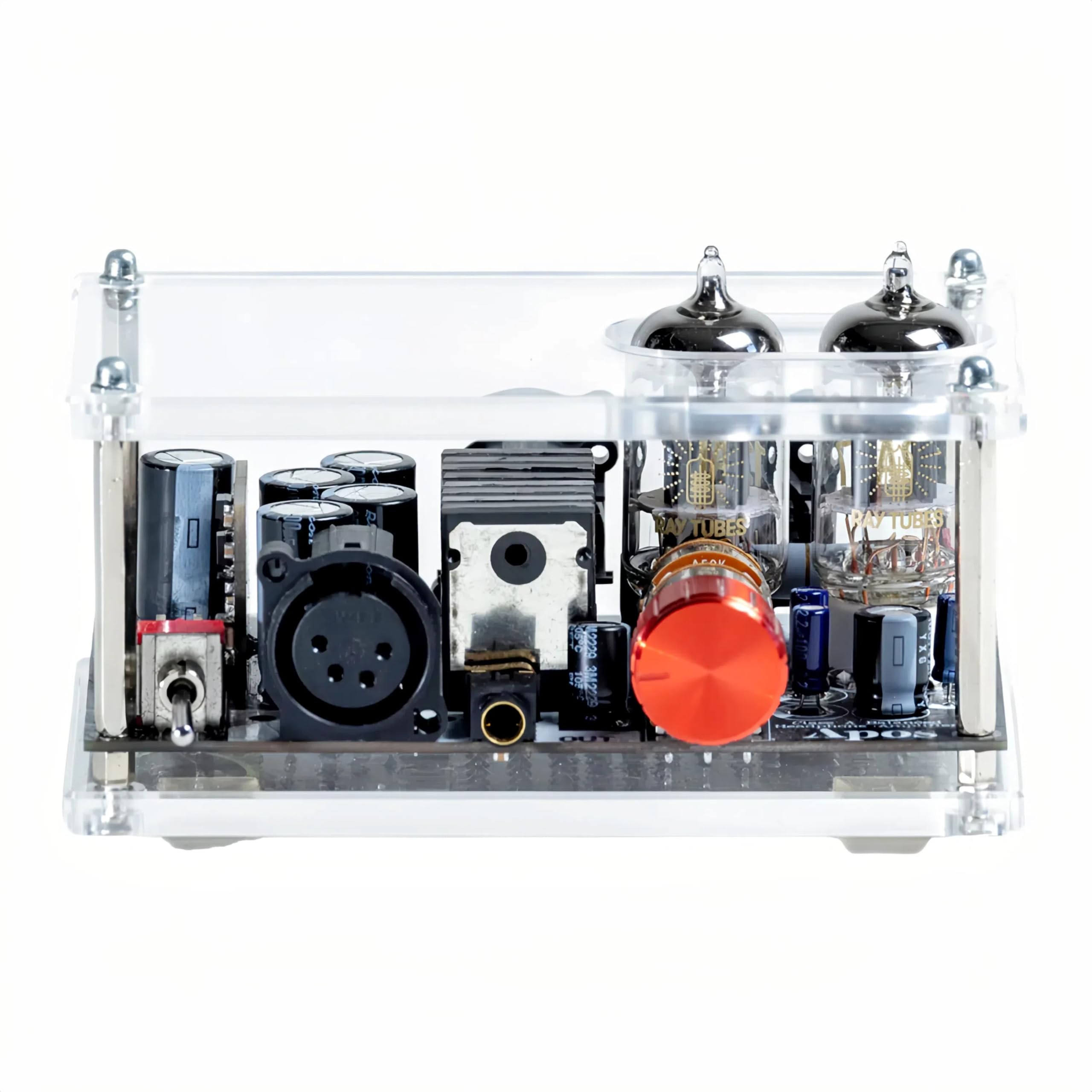
3. Apos Gremlin Headphone Tube Amplifier
The little tube amp that packs a ferocious 1250mW bite and melts away harsh digital treble.
If you’re curious about tube sound but don’t want to spend a fortune, the Gremlin is your gateway. It’s a Class A, fully-balanced hybrid that combines the precision of transistors with the warmth of vacuum tubes. Owners describe the sound as “sumptuous and lush” with “heart-melting mids,” and it’s particularly good at taming the piercing treble of some in-ear monitors.
It drives most headphones thanks to its 1250mW of output power—plenty for planars like the Dan Clark Noire X. The fully balanced design—with balanced XLR inputs and both 4-pin XLR and 4.4mm outputs—keeps hum and interference at bay, which is crucial for sensitive IEMs.
The real fun is tube rolling. It comes with a matched pair of CORE 12AU7 tubes, but you can swap in any 12AU7 or 6922, new or old. Buyers recommend Gold Lion tubes for a quieter, clearer sound, and note that NOS (New Old Stock) Mullard tubes are a real treat. It needs a 15-30 minute warm-up and a 6-hour burn-in to fully settle.
What Wins People Over
- Sound quality is rated as the top aspect—customers note it outperforms amps that cost five times as much.
- Tube selection is a big draw, with owners appreciating the excellent choice of included tubes.
- Hybrid design offers tube warmth without the full maintenance of a pure tube amp.
The Trade-Offs
- It’s a small, exposed-chassis design—”ugly, naked, and small” as the maker puts it—so it won’t win any desk beauty contests.
- Requires patience: a 15-30 min warm-up and a 6-hour burn-in period.
- Tubes have a finite lifespan (around 10k hours), so budget for eventual replacement.
Reach for this if: you want an affordable entry into tube rolling and crave that rich, warm harmonic texture.
Think twice if: you need an amp that’s ready to go the instant you power it up, or you prefer a minimal, closed-chassis aesthetic.
4. Fosi Audio ZH3 DAC Headphone Amp

A fully-featured desktop hub with 2570mW of balanced power and a 24-month warranty.
This is the Swiss Army knife of the list. The ZH3 functions as a DAC, headphone amp, and preamp, with premium chipsets—including the AKM4493SEQ DAC and XMOS XU316 processor—delivering a low 1.9μV noise floor. Buyers consistently praise its “phenomenal sound quality” and strong stereo imaging.
You get plenty of power: 640mW@32Ω on the 6.35mm single-ended output and a sturdy 2570mW@32Ω on the 4.4mm balanced output. The 3-level gain switch handles headphones from 16Ω to 300Ω, so it’s a safe bet for almost any IEM or over-ear headphone. It works flawlessly with gaming consoles via USB, and the bass/treble EQ plus 6 filter types let you dial in your preferred sound signature.
One honest caveat: while it’s marketed as a preamp, the XLR output is fixed line-level—there’s no volume control on the preamp outputs, which disappointed a few buyers expecting an analog preamp. The EQ also only affects the headphone output, not the speaker outs.
Performance Winner: Reviewers point out that the built-in DAC/amp outperforms the Schiit Modi 3+/Magni+ combo, delivering clearer, more detailed sound. It’s a “great value” that rivals units two to three times the price.
Not a True Preamp: The XLR fixed line-level output means you’ll need volume control from your source or a separate preamp if you want to drive powered monitors directly.
The pick for: gamers and desktop users who want one compact box that handles USB from a PS5 or PC, drives headphones with authority, and feeds active speakers.
Not for: those who specifically need a variable-volume preamp output for controlling powered monitors from the desk.
5. Douk Audio Tube Headphone Amp E2
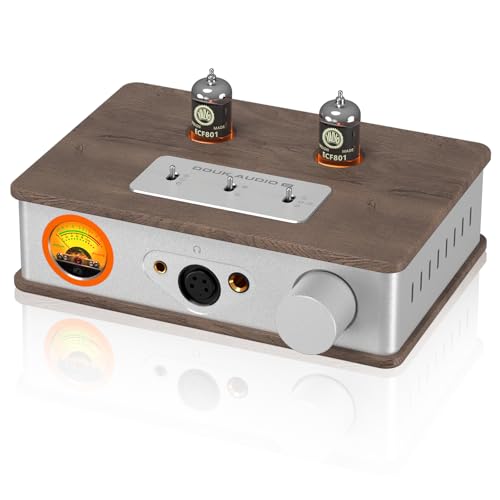
Walnut, glowing tubes, and 2000mW of warm power make this a functional piece of art.
The E2 is as much a visual centerpiece as it is an amplifier. With its walnut wood panels, vintage VU meters, and exposed German Valvo ECF801 tubes, it brings a retro-industrial elegance to any desk. But the beauty is more than skin deep—owners describe the sound as “rich and smooth,” with one noting they can hear “every critical detail” of instruments like guitar and piano.
Under the hood, it uses dual TPA6120 chips to deliver 2000mW of power, enough to drive demanding models like the Sennheiser HD650 or Beyerdynamic DT 990. The triple jacks—XLR, 4.4mm, and 6.35mm—cover all modern balanced and single-ended connections, and the included 6.35mm-to-3.5mm adapter extends compatibility to IEMs.
It truly shines as a dual-mode device: use it as a standalone preamp for studio monitors or desktop speakers, or run the headphone and speaker outputs simultaneously for private monitoring. Audiophile reviewers have tested it against units at five times the price and preferred the E2’s clean, warm, and clear presentation.
Sound Quality First: The most-praised aspect is the sound—big, holographic soundstage that reveals subtle details with a fun, enjoyable tone.
The Rare Tube Problem: The Valvo ECF801 tubes are rare, so replacements are hard to find and may cost -60 per pair plus international shipping.
Reach for this if: you want a beautiful, warm-sounding tube amp/preamp that doubles as a desk ornament and drives a wide range of headphones.
Think twice if: you prefer a neutral, transparent solid-state sound, or you’re worried about sourcing hard-to-find replacement tubes down the line.
6. Topping L70 Fully Balanced NFCA Headphone Amp

A dead-silent, 146dB dynamic range amplifier that turns your desktop into a recording-studio reference.
The L70 is a solid-state purist’s dream. It uses the same NFCA (Nested Feedback Composite Amplifier) module as Topping’s flagship A90, delivering ultra-low THD+N and an absurdly high 146dB dynamic range. Owners call it “end-game quality” and note that it pairs brilliantly with the E70 DAC for a clean, natural sound.
With 7500mW x2 of output power, it drives virtually any headphone—high-impedance dynamics, low-impedance planars, and even sensitive IEMs without background hiss. The fully balanced circuit handles 4-pin XLR, 4.4mm, 6.35mm, and 3.5mm jacks, and the R2R relay volume control ensures precise channel matching at any level.
The recurring complaint is specific: with low-impedance, high-sensitivity planar headphones, the “safe mode” cuts audio above volume 70. A firmware update didn’t fully resolve it for some owners, so those with picky planars might want to look at the A70 Pro instead. For high-impedance dynamics, it’s flawless.
The Highlights
- Dead-silent noise floor with superb imaging and detail, especially paired with DT 1770 Pro MKIIs.
- Excellent build quality and functionality, with a crisp display and DPLL settings for optical input.
- Works great as a preamp with flexible 20ohm SE and 40ohm balanced output impedance.
The Flaw
- Safe-mode volume cutoff above 70 with low-impedance, high-sensitivity planars is a dealbreaker for some planar owners.
- No built-in DAC—you’ll need a separate unit like the E70.
The pick for: high-impedance dynamic headphone owners who want a state-of-the-art, transparent solid-state amp with flexible input/output options.
Not for: owners of sensitive planar magnetics like the Audeze LCD series, who may hit the volume cutoff.
7. HIFIMAN EF499 Desktop Balanced Headphone DAC & Amplifier

A hefty R2R DAC/amp with a vertical design that doubles as a headphone stand and streams from your NAS.
The EF499 is a different kind of desktop component. Its vertical tower design means it takes up minimal desk space and can even serve as a headphone stand, which is a clever touch. More importantly, it features HIFIMAN’s R2R architecture, delivering a warm, full-range sound that shoppers say is “remarkably close” to their reference Hymalaya DACs.
With a 4.35W balanced output, it has ample power for demanding planars—buyers report it pairs beautifully with the HIFIMAN Arya Stealth V3. The front panel includes a 4-level function switch (High Gain NOS, High Gain OS, Low Gain OS, Low Gain NOS), letting you choose between different digital filter modes to tailor the sound.
For source flexibility, it’s a streaming powerhouse. Plug in a network cable and it can play files directly from a connected NAS drive, or stream from your favorite apps. It also works as a traditional DAC/amp via USB-B, USB-C, or coaxial input. Owners mention it works with Linux and streams via AppleCast.
Build & Value: Owners call it “heavy, solid, and a good value,” with premium construction that doesn’t feel cheap. USB-C works with iPhone 15 for quick phone listening.
Minor Quirks: The volume knob doesn’t control the XLR output, and the line out doesn’t switch off when headphones are connected—both are worth knowing before you buy.
The pick for: R2R fans who want a warm, musical DAC/amp combo with network streaming and a space-saving vertical footprint.
Not for: those who need the volume knob to control powered speakers via XLR, or who want a traditional low-profile DAC form factor.
8. Topping DX5 II Fully Balanced DAC Headphone Amp Combo
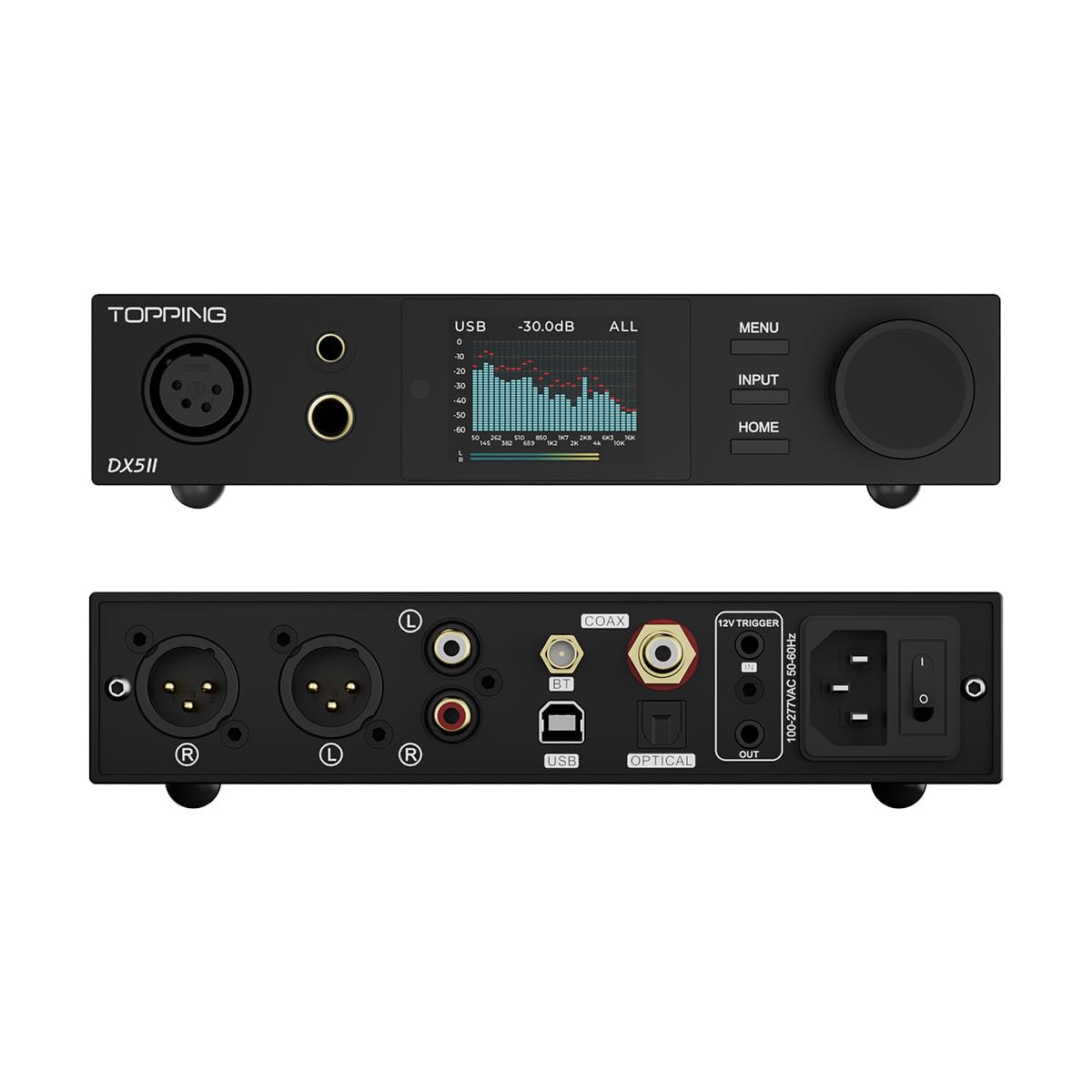
A dual-ESS-chip combo that offers 7600mW of balanced power and a 10-band PEQ in one box.
The DX5 II is Topping’s do-everything solution, combining a fully balanced DAC and headphone amp in a single chassis. Each channel gets its own ES9039Q2M DAC chip, which improves channel separation and imaging, backed by a 133dB SNR and distortion as low as 0.00006%. It’s a “crisp” sound that customers note is flawless in performance.
Power peaks at 7600mW x2 into 16Ω, making it strong enough for basically any headphone, while the low 1.8μVrms noise floor keeps sensitive IEMs hiss-free. The X-Hybrid amplifier circuit uses a discrete input stage and op-amp gain stage for high efficiency and precise volume delivery.
The 10-band PEQ is the standout feature. The desktop software lets you adjust frequency, gain, and Q-factor across 10 independent bands, save multiple profiles, and apply different EQ to speakers vs. headphones. You can also import and export curves to share with friends. Wireless is covered via the QCC5125 chip with LDAC support up to 96kHz/24bit.
The Strong Suits
- Strong headphone amp section that buyers call the “strongest in its price range,” with 7600mW peaks.
- Superb value—owners call it an “end game” DAC/amp that drives 99% of headphones.
- Customizable EQ profiles saved to the device itself.
The Caveats
- Cannot set a separate PEQ profile per output (headphone vs. speaker).
- Some users find the DSP/EQ processing degrades the pure sound if left active.
- A few reviewers point out a frustrating initial unit that needed replacing.
Reach for this if: you want a single-box DAC/amp with tons of power, extensive EQ customization, and wireless LDAC for Bluetooth listening.
Look elsewhere if: you prefer to keep your DAC and amp separate for future upgrades, or you need separate EQ profiles for different outputs.
9. Topping A70 Pro Fully Balanced Headphone Amplifier Preamp

The 17,000mW desktop beast that drives even the most demanding planars with easy headroom.
This is the amp for people who refuse to compromise on headroom. The A70 Pro’s 17000mW x2 output is the highest on this list, and shoppers say it powers their headphones “to earbleeding levels” without breaking a sweat. It drives HIFIMAN and AKG models easily, making it a natural match for power-hungry planar magnetics.
The new T’ang-ku-la Module uses a three-stage feedback circuit to push the dynamic range to 147dB while reducing heat generation—a real win for long listening sessions and component longevity. The GND/LIFT switch is a lifesaver if you ever run into ground loop hum in a multi-device setup.
Its R2R relay volume control uses relays and resistor networks for precise, long-lasting volume adjustment that never drifts. It also works as a high-performance preamp with RCA output impedance of 50Ω and XLR output of 100Ω, so it pairs cleanly with a wide range of power amplifiers.
Why It’s Special
- class-leading power output makes it the cheapest “beast” owners have come across for driving planars.
- Versatile: works great as both a headphone amp and a preamp, with excellent build quality.
- R2R volume control ensures precise, reliable volume levels even at low settings.
The Known Flaw
- Safe-mode volume cutoff above 70 with low-impedance, high-sensitivity planar headphones—a firmware issue that wasn’t fully resolved for some.
- Heavier than most at 4.82 pounds, so it’s a permanent desk fixture, not a travel companion.
The pick for: serious planar headphone owners who need massive headroom and want the flexibility of a relay-controlled preamp.
Not for: those using low-impedance, high-sensitivity planars, who may trip the safe-mode volume cutoff.
Understanding the Specs
Output Power (mW)
Milliwatts measure how much electrical power the amp can deliver to your headphones, but only in the context of impedance (measured in ohms). A high mW rating at 32Ω means the amp has strong current for low-impedance planars, while a high mW rating at 300Ω means it has the voltage to drive high-impedance dynamics. Always compare power at the same impedance load; the FiiO K13’s 2400mW and the Apos Gremlin’s 1250mW are both respectable, but the A70 Pro’s 17000mW is in another league entirely.
Balanced vs. Single-Ended
Balanced connections (XLR and 4.4mm) use separate positive and negative signal paths for each channel, doubling the voltage swing and canceling common-mode noise (interference picked up equally on both lines). Single-ended (6.35mm and 3.5mm) uses a single signal path and ground. Balanced is objectively better for channel separation and noise rejection, but you’ll only hear the difference with long cable runs or sensitive gear. All amps here offer both, so your choice depends on your headphone’s native connector.
R2R vs. Delta-Sigma DAC
R2R DACs (like in the FiiO K13 and HIFIMAN EF499) use resistor ladders to convert digital to analog directly, producing a warmer, more “analog-like” sound with natural timbre. Delta-Sigma DACs (like the CS43131 in the S.M.S.L M300SE and ES9039Q2M in the Topping DX5 II) use oversampling and noise shaping for higher measured accuracy but can sound more clinical. It’s a preference, not a quality difference—both can sound excellent.
NOS/OS Modes
NOS (Non-Oversampling) mode plays the audio at its original sampling rate for a pure, natural sound. OS (Oversampling) mode up-samples the signal (to 384kHz on the FiiO K13) to improve measured audio metrics, delivering a finer and clearer sound. Some listeners prefer NOS for its relaxed character, while others prefer OS for its precision. The FiiO K13 and HIFIMAN EF499 let you switch between them to match your mood.
FAQ
What does XLR do in a headphone amplifier?
Is a balanced headphone amp always better than single-ended?
Will an XLR amp drive my high-impedance 300-ohm headphones?
What is the difference between a 4.4mm and a 4-pin XLR balanced output?
How many milliwatts (mW) do I really need for my headphones?
Will a tube amp like the Apos Gremlin work with sensitive in-ear monitors?
Do I need a separate DAC if I buy a headphone amp like the Topping L70?
What is the benefit of a DAC/amp combo versus a separate DAC and amp?
How long do vacuum tubes last in a tube headphone amp?
Final Thoughts: The Verdict
For most people, the xlr headphone amplifier winner is the FiiO K13 R2R because it delivers class-leading R2R warmth, 2400mW of power, and a feature set—PEQ, LDAC Bluetooth, and multiple outputs—that makes it a true desktop hub. If you want pure tube charm and love the idea of rolling tubes to shape your sound, grab the Apos Gremlin. And for the planar headphone owner who needs uncompromising headroom, the Topping A70 Pro is the one to reach for.
How We Picked
We do not accept paid placement. Every pick is matched to a real buyer and a real use-case; we do not hands-on test units.
Sources & Methodology
Specifications: manufacturer listings and product documentation. Review insights: verified customer reviews, as of August 2026. Pricing: not shown on this page (it changes often); check the current price via the retailer link.