
Whether a robot vacuum can go over a threshold depends on the height of the obstacle and the vacuum’s climbing ability. Most modern models can handle common transition strips and low-profile door sills, but taller thresholds or steps often require strategic solutions like ramps or virtual barriers. Understanding your specific model’s specs and your home’s layout is key to a smooth, automated clean.
Key Takeaways
- Check the Climbing Spec: Your vacuum’s manual lists its maximum climbing ability, typically between 0.5 to 0.8 inches (15-20mm). Measure your thresholds first.
- Low-Profile is Usually Fine: Common transition strips and carpet-to-hardwood edges under 0.6 inches are often surmountable by mid-range and premium robots.
- Tall Thresholds are a Barrier: Standard door sills or steps over 0.75 inches will likely stop most robots, requiring a physical ramp or manual assistance.
- Use Smart Features to Help: Virtual walls, no-go zones, and room-specific cleaning can keep your robot in safe areas or guide it over tricky spots.
- Preparation is Powerful: Simple DIY solutions like adhesive ramps or strategic mat placement can create a bridge for your robot to climb.
- Not All Robots are Equal: Models with large wheels, strong motors, and advanced navigation (LIDAR) generally handle obstacles better than basic, random-bounce models.
- Safety is Paramount: Always ensure the robot cannot fall down stairs. Use physical barriers or virtual boundaries to prevent accidents.
Can Robot Vacuums Go Over Thresholds Successfully? Your Complete Guide
You just got a shiny new robot vacuum. You imagine it whirring through your entire home, keeping every room spotless. Then you see it. That little ridge between your kitchen and living room. That metal strip in the doorway. The step down into the sunroom. A big question pops into your head: can this little robot get over that?
The short answer is: it depends. But don’t worry. This guide will explain everything. We will talk about different types of thresholds. We will look at what makes a robot good at climbing. And we will give you simple steps and smart tips to help your robot succeed. By the end, you’ll know exactly what your robot can handle and how to help it clean your whole home.
Understanding Thresholds and Your Robot’s Limits
First, let’s define what we mean by a “threshold.” It’s any raised edge or change in floor height between two spaces. Not all thresholds are the same.
Visual guide about Can Robot Vacuums Go Over Thresholds Successfully
Image source: cdn-bande.nitrocdn.com
Common Types of Home Thresholds
- Transition Strips: These are metal or wooden strips. They cover the seam between two different floor types. For example, between tile and hardwood. They are usually thin and low.
- Door Sills (or Saddles): These are found in exterior doorways or between rooms. They can be made of wood, metal, or marble. Their height can vary a lot.
- Step-Downs/Lips: A small step, often where a room has been added on. This could be a single step down into a sunroom or den.
- Carpet to Hard Floor Edges: The edge where thick carpet meets a hard floor can create a noticeable bump.
The Magic Number: Maximum Climbing Ability
Every robot vacuum has a specification called “maximum climbing ability” or “obstacle clearance.” This is the tallest obstacle it’s designed to go over. You can find this number in your user manual or on the product’s website.
- Basic Models: Often can climb only 0.5 inches (about 13mm) or less.
- Mid-Range to Premium Models: Typically handle 0.6 to 0.8 inches (15-20mm). Some high-end models claim up to 0.9 inches (23mm).
Your first task is simple: find your robot’s number, then measure your thresholds with a tape measure. If the threshold is shorter than your robot’s limit, you’re likely in good shape. If it’s taller, you’ll need a plan.
Step-by-Step: Preparing Your Robot for Thresholds
Follow these steps to set your robot up for success.
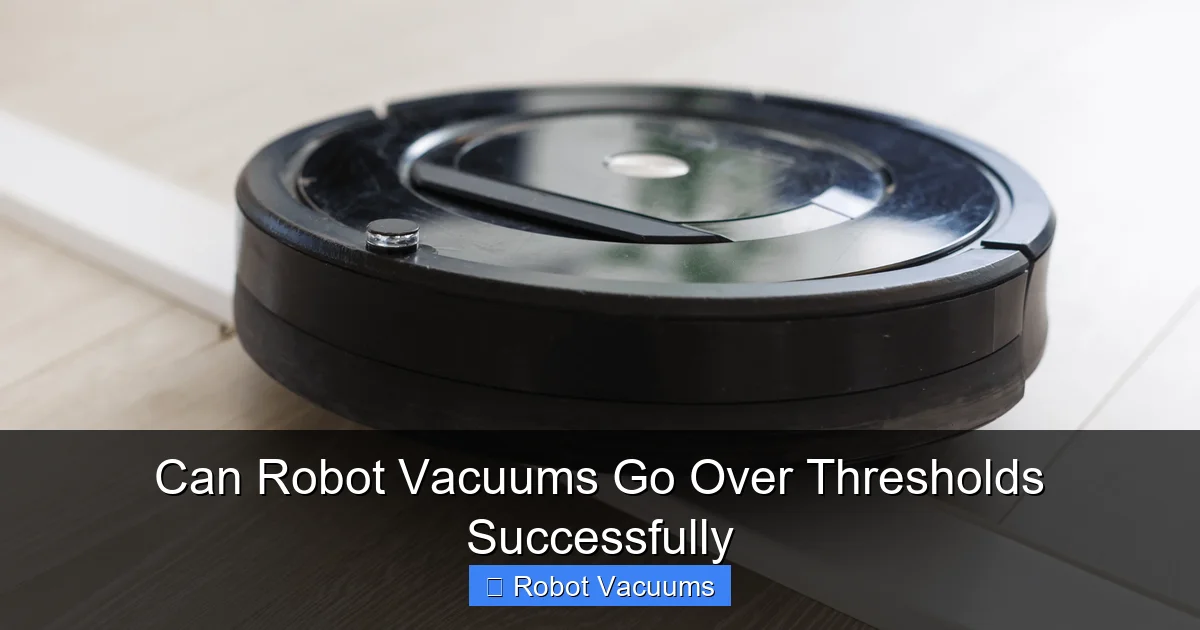
Visual guide about Can Robot Vacuums Go Over Thresholds Successfully
Image source: robotchores.com
Step 1: Audit Your Home’s Thresholds
Grab a tape measure and a notepad. Walk through your home. Find every single threshold, step, or ridge. Measure its height. Write it down and note its location. This gives you a clear map of the challenges.
Step 2: Know Your Robot’s Specs and Features
Look up your robot’s climbing ability. Also, check its other features. Does it have LIDAR navigation for smart mapping? Can you set up “No-Go Zones” or “Virtual Walls” in its app? These features are powerful tools for managing thresholds.
Step 3: The Initial Test Run (Supervised!)
Don’t just set it and forget it on the first run. Place your robot near a measured threshold. Watch how it approaches the obstacle. Does it bump, try to climb, and succeed? Or does it repeatedly bump and give up, marking it as a wall in its map? Your direct observation is the best data.
Practical Solutions for Different Scenarios
Based on your audit and test, use these solutions.
Visual guide about Can Robot Vacuums Go Over Thresholds Successfully
Image source: cdn-bande.nitrocdn.com
For Low Thresholds (Under 0.6 inches / 15mm)
Most robots should handle these. To improve success:
- Ensure a Clean Approach: Make sure the floor leading to the threshold is clear of cords or rugs that could hinder its approach speed.
- Check Tire Tread: Keep the robot’s drive wheels clean. Dust and hair can reduce traction.
For Moderate Thresholds (0.6 – 0.8 inches / 15-20mm)
This is the challenge zone. It’s at the limit for many robots.
- Use Momentum: Sometimes, a longer, clearer approach path helps the robot build up speed to climb over.
- Employ Smart Mapping: If your robot has it, create a clean run. Tell it to clean the room on the other side of the threshold. It will often approach with more determination from its charging dock.
- The DIY Ramp: A simple, low-angle ramp can turn an insurmountable cliff into a gentle slope. You can use a thin, flexible plastic threshold ramp from a hardware store. Secure it with strong double-sided tape.
For High Thresholds and Steps (Over 0.8 inches / 20mm)
Most robots cannot climb these. Your options are:
- Permanent Ramp: Install a custom wooden or rubber ramp. Sand it smooth and secure it properly. This is a great solution for a problematic step into a sunroom.
- Strategic Mat Placement: A thin, firm door mat can sometimes bridge a gap or reduce a step’s effective height.
- Containment Strategy: Use a physical magnetic strip (for older models) or a virtual no-go zone (for smart models) to block access. Then, you can manually carry the robot to the other area for a separate cleaning cycle.
Troubleshooting Common Threshold Problems
What if your robot should make it over but doesn’t? Try this.
Problem: The Robot Bumps and Turns Away
It might think the threshold is a wall. Reset its map (if it has one) and try a supervised test run again. Sometimes, helping it over once teaches it the path is clear.
Problem: The Robot Gets Stuck “High-Centering”
This means it climbs partway but its underside gets caught on the peak. The threshold is too tall or too sharp. A ramp is your only solution here to create a smoother transition.
Problem: Inconsistent Success
It makes it over one time but not the next. This is often due to approach angle or wheel traction. Ensure the approach path is always clear. Clean the robot’s wheels and sensors.
Essential Safety Tips
Never forget safety when dealing with thresholds and drops.
- Stairs are the Biggest Danger: Your robot’s cliff sensors should prevent falls, but never rely on them 100%. Use the provided physical boundary strips or virtual barriers to block off staircases completely.
- Secure Ramps: Any ramp you add must be firmly attached to the floor. A slipping ramp could damage your floors or trap the robot.
- Monitor Wear and Tear: Constant climbing can stress the robot’s drivetrain. Listen for new grinding noises and check for wheel damage periodically.
Conclusion: Smart Cleaning for a Seamless Home
So, can robot vacuums go over thresholds successfully? Absolutely, but it takes a little knowledge and sometimes a simple hack. The key is to understand the partnership between your home’s layout and your machine’s capabilities. Start by measuring and knowing your robot’s specs. Use its smart features to your advantage. And don’t be afraid to use a simple, low-profile ramp for those tricky spots.
With this guide, you’re equipped to solve the threshold puzzle. Your robot vacuum can now move more freely. It can keep more of your home clean with less effort from you. That’s the promise of automation fulfilled. Happy, seamless cleaning!
🎥 Related Video: Roborock Qrevo Curv climbs over door sill / threshold
📺 afterdawncom
Roborock Qrevo Curv can lift its body in order to climb over door thresholds (sills). In this video Qrevo Curv returns back from the …